Feeds:
Posts
Comments

Archive for the ‘Expat in Italy’ Category

The opinions expressed herein are those of the author (me) and may not reflect the opinions of the reader (you). There is absolutely no assurance that any statement contained in this article is true, correct or reliable. The opinions are based solely on observation and personal experience.  The foregoing is presented from the point of view of the author (me).  …”usate il sale in zucca” (an idiom loosely translated means “take it with a grain of salt”).***

The Grass is Always Greener
2012-04-25 13.54.32I want to begin by saying that I’ve done it, you’ve done it, we’ve all done it at one time or another. We really must stop doing it: expatriates sitting around moaning and groaning about how things function (or don’t function) in Italy.  First of all, can you imagine how we must sound to Italians within ear-shot of our tasteless and unflattering belly-aching? Openly criticizing the country and people who have welcomed us into their “home” is not only impolite, it’s incredibly tacky. We made a choice to leave our native land and relocate to another, did our research and knew what to expect when we took the leap.

An analogy to illustrate my point: George Clooney has infamously left a long line of beautiful starlets in his wake. Elisabetta Canalis is out and now you are George’s new girlfriend. He is so charming, handsome, rich and powerful. You attend red carpet events on his arm in Versace, appear on the cover of People magazine and spend long weekends on Lake Como with “Brangelina”. Of course he eventually dumps you and deep-down inside you’re not surprised – this is who he is and what he does. Expats in Italy…we knew what we were getting into – Italia is who she is and what she does – let’s lighten up and stop complaining already!

We Aren’t in Kansas Anymore

It’s an exercise in futility to compare our homeland to Italy.  Italy is different – isn’t that one of the reasons we decided to pack up and move in the first place? Heinz ketchup, Mexican food, peanut butter – the list of things from home that you can’t get in Italy is as long as my arm (and vice versa, I might add).  I’m guilty, I admit it.  I’ve been a “mule” for friends – bringing  back suitcases full of taco seasoning, ranch dressing, vanilla extract and ibuprofen. Comforts from home are really lovely to have, nevertheless we should try to be more adaptable and use the products available …conform, fit in, go native!

Talking Points

This one is so obvious, I shouldn’t have to say it: speak Italian. When we live abroad of course we gravitate towards a crowd with a common culture and background. I try not to use my English-speaking friends as a crutch to avoid Italian proficiency because I know that I can never, ever form lasting and deep relationships with Italians if I don’t speak their language.  Unfortunately there is only one way to accomplish this…open our mouths and talk.  My Italian is substandard to say the least and I make errors constantly.  I once told a man that my grandfather was born in “coglione” (which means “testicles”).  We both laughed until we cried.  May I recommend the “Italian by Osmosis” system?  Watch weird Italian television, read the local newspaper, listen to pop music on the car radio, try telling a joke in Italian and above all, be willing to feel awkward and sound stupid.  Italians are very gracious and will appreciate the effort.

Home is Where the Heart Is
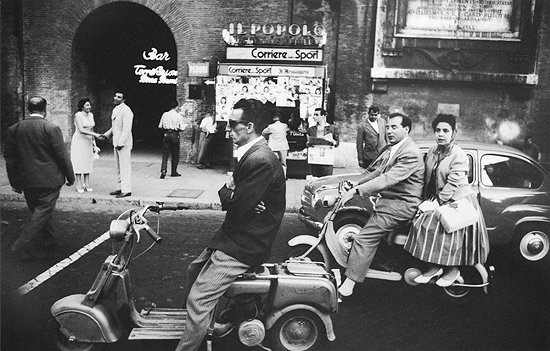
Photo by W. Klein

It seems to me that life is full of wonderful opportunities to evolve and expand our horizons.  Living abroad is something that takes a certain kind of daring individual with lots of resilience and an open heart.  Make fun of yourself and the absurdity of it all.  Relax, enjoy, grin and bear it and REJOICE…you live in Italy for God’s sake!

***No actual expatriates were harmed in the writing of this article.


by Toni DeBella

Read Full Post »

Twenty years from now you will be more disappointed by the things you didn’t do than by the ones you did do. So throw off the bowlines, sail away from the safe harbor. Catch the trade winds in your sails. Explore. Dream. Discover.” – Mark Twain

In a perfect world there would be no boundaries and we would all be citizens of the world, free to roam from place to place at our heart’s desire. Until that day comes, you’re going to need a government-issued passport.

Passport 101

King Henry V of England, most noted for his great military mind is also credited with inventing what is considered the modern version of the passport. Earlier references to the passport have also been found in the Hebrew Bible. In medieval Europe a document was required in order to pass through the gates of a city wall or traverse a territory.

American in Paris?

The latest statistic regarding the percentage of Americans (less than 30%) who own passports is a little sobering and quite frankly, a bit suspect. I disagree with the popular assumption that Americans are fundamentally unadventurous, isolation-loving people without a global perspective. I assert that the low number of passports issued is misleading and actually a reflection of many mitigating factors including: 1) The geographical make-up of the United States. It is a vast, diverse land filled with amazing places (national parks, big cities, beautiful beaches, majestic mountains, etc.,) that keep Americans sightseeing within its borders; 2) The U.S. neighbors only two other nations, unlike Europe which has nearly a total of 50 border-crossings on its continent. For example, an Austrian boards a one-hour flight or sets out on an eight-hour car trip and reaches a myriad of foreign countries. A one-hour flight from San Francisco takes me as far as Los Angeles, Las Vegas, Portland, and somewhere in the middle of the Pacific Ocean; 3) If you are a member of the working middle-class it is likely you have only two-weeks vacation a year and on top of that; 4) foreign excursions can be quite expensive.

But for those who choose to hold a passport, they hold unlimited possibilities in their hands. This tiny book has power. With it you have permission to pick-up and jet-off to strange and exotic locations at a moments notice. My son has let his passport expire and I am continually nagging him to get it renewed. “You never know when you might need to fly to Paris for lunch”, I say. He rolls his eyes. He’s right, this situation doesn’t come up too often – but it never hurts to be ready just in case. As for me, I caught the “travel bug” later in life and I caught it with a vengeance. Just recently I renewed my passport and sweated those few weeks without it. It was a relief to find it in the post safe and sound. I look forward to the next 10 years of gallivanting.

My recent passport is only the third in my lifetime. Growing up in our family meant we never ventured farther than our Ford Country Squire station wagon could take us. In college, I went to Mexico quite a few times, but back in “the day” you weren’t required to carry documents to go south or north of the border. In 1982 I took my first international flight to Sydney, Australia for a friend’s wedding and joined the prestigious group “world traveller”. Since that time I’ve been to only a handful of different countries: Mexico (twice), Costa Rica, The Bahamas, England (twice), Germany (twice) and of course, Italy (dozens of times). In two months time I will be adding France to that list. My Passport Personality: Late Bloomer.

On this ever-changing, fluid planet it is nearly impossible to maintain an accurate list of countries in the world. The Travelers’ Century Club has compiled a “Master List” of countries, territories, autonomous regions, island groups, states and provinces that theoretically make up the world. Currently there are 872 places pinpointed. No one person has visited them all, but a few have come close. My friend Marisa is in her 30s and has one of the most impressive passports I’ve ever seen. (The photo at the top is from a page in her actual passbook). She considers it among her most prized possession. She’s travelled since she was a baby and in her teens and early 20s lived many years abroad (both on land and on boats). She is now gainfully employed as a maritime attorney, so her globe-trotting has stalled a bit. But deep down inside she will always have the heart of a vagabond and wanderlust in her veins. Her Passport Personality: Marco Polo.

So, what does your passport say about you?

by Toni DeBella

Read Full Post »

February, 2009

A friend was visiting on a sunny, frigidly cold winter’s day when most people would have preferred to stay indoors and keep warm. Not us. We hopped on a bus that dropped us in Bagnoregio, then hiked up to the footbridge to the top of Civita’.

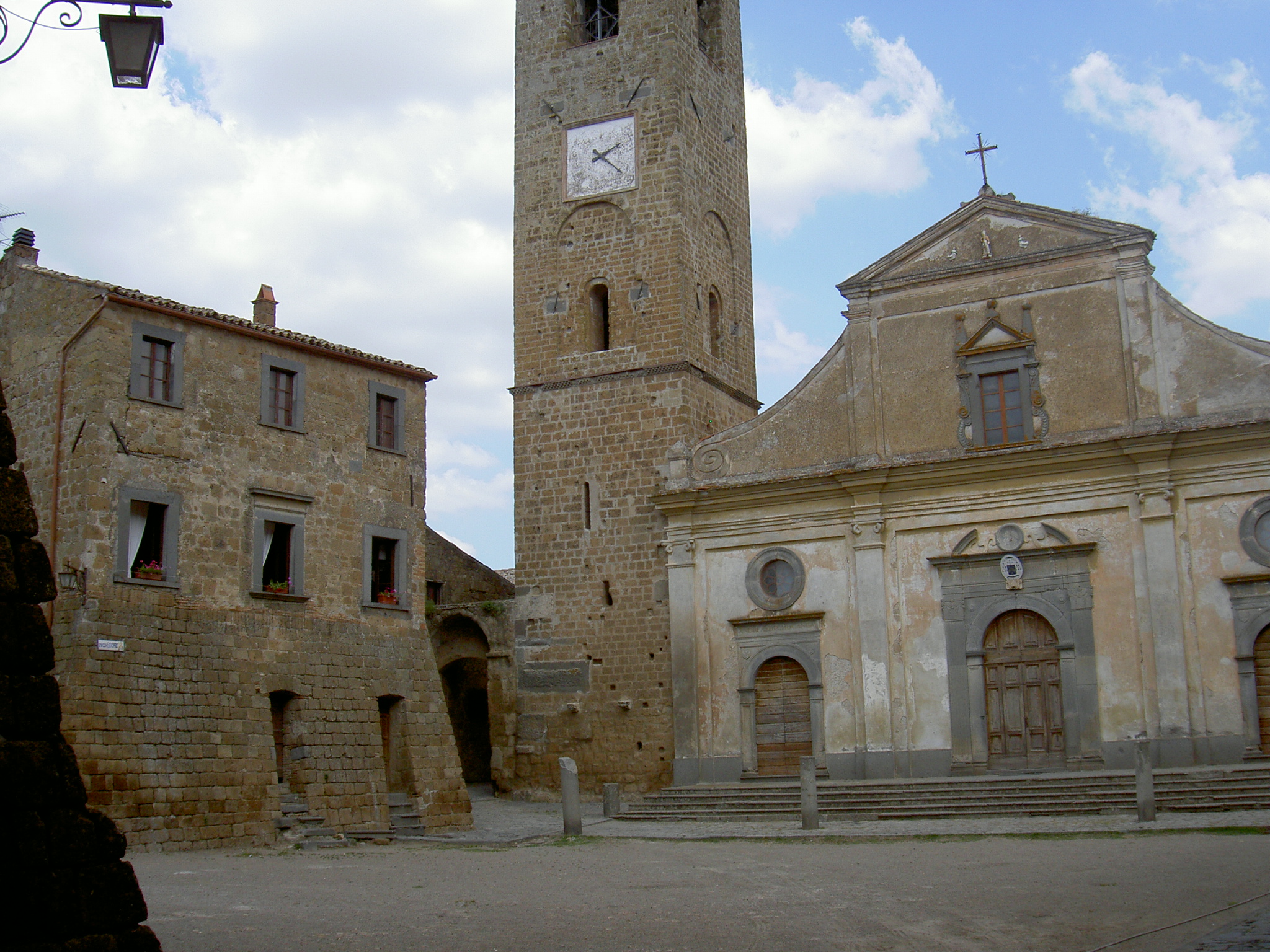
CivitaCivita’ di Bagnoregio (“the dying town”) is located 145km north of Rome in the region of Lazio, overlooking the Tiber Valley. The village seems to float above the earth in a cloud, but has the unfortunate distinction of being one of the world’s most endangered places; the town is slowly crumbling and sliding down its cliffs.

This little borgo has always had a strange allure for me (as it has, I’m sure, for millions of others who have experienced visited). The atmosphere that day was a little eerie because there didn’t appear to be any other souls in town (except  two ambling cats in the main square). It’s a favorite stop of tourists in the spring and summer, but on this February afternoon, the streets were quiet and deserted; underscoring the heartbreaking reality of the city’s inevitability. I’ve visited Civita’ three times in my life. The first was as a tourist. The second was as a dinner guest at the home of a friend (which was pretty amazing considering there are only a dozen residents remaining in this little hamlet). My last visit was by far the most memorable.

A small sign hanging in a courtyard is the only indication that there’s a thriving business inside a grotta at the end of the enchanting patio. Bruschetteria L’Antico Frantoio is too tiny to be called a cafe’, and the menu is too limited to be a restaurant – so it’s simply called a “bruschetteria”. I imagine it’s like no other bruschetteria in Italy. The Rocchi family has been operating this iconic destination of travelers for decades with its 1500 year-old olive oil mill (frantoio) in the back. The mill, which still functions (although it’s retired) has been in the family since 1520. Today, the family’s Agriturismo “Le Corone” in a valley nearby produces all of its oil.

On this day, Felice Rocchi was our host and chef. A remarkably efficient use of space, there is only a fireplace to grill the bread, a counter to assemble and serve the bruschetta and wine, and a few tables covered in tablecloths. I think we were Felice’s only customers that day and since we were in no hurry to return into the freezing wind, the three of us passed a very pleasant afternoon talking and eating the most amazing olive oil-soaked bruschetta and drinking the freshest house red wine. We chatted about Felice’s family, got a private tour of the Etruscan well in the cantina, and together devised a kooky plan to help bewildered Jtourists how and what to order. He promised us a cut of the projected profits from our little scheme, but I think when I return, I’ll ask for my share to be paid in bruschetta.


by Toni DeBella

Read Full Post »

One of my great fortunes in life is having two close friends who work as Flight Attendants for major international airlines.  These two women both collectively and single-handedly enable me to feed my addiction to Italy (or as I sometimes like to refer to it, “my crack”).  The companion fare or “buddy pass” is a way of traveling that’s not for the faint of heart.  It requires nerves of steel, the patience of Job, the imagination of Sherlock Holmes, and the ingenuity and resourcefulness of MacGyver.  It also helps to have an innate ability to build alliances and form coalitions with the other “buddies” in line for the few choice “non-revenue” seats.  It’s sort of like “Survivor”, but in an airport. Companion fares are a fraction of the cost of a regular ticket, but as the old adage goes, “You Get What You Pay For.”

Don’t misunderstand me, I am eternally grateful to my friends for sharing their privileges with me, however, if you’re planning to travel this way, you must go in with your eyes wide open and accept its cruel game of “standby roulette”.  I’ve sat many a time at the gate testing the theory that it’s possible to telepathically compel myself onto the airplane by chanting over-and-over-again, “please call my name, please call my name, please call my name” (like some twisted mantra to will the gate agent (who’s forehead I’ve just burned a hole through) to say those 7 magic words, “passenger DeBella, please come to the podium”.

Ahh, the sweet glory of nabbing a seat in business class from New York to Rome! Warm nuts, champagne, fluffy socks, a blanket made of natural fiber and, the pièce de résistance, a seat that reclines almost flat.  Once you’ve flown business class, it’s hard to return to coach.  In the back, (an airline industry term for “where the losers sit”) I feel like an immigrant crammed into steerage on the Titanic.  Should things go awry, I’m convinced any real lifesaving procedures will be afforded to the platinum American Express cardholders first.  However, I’m not thinking about that today – today I’m one of them.  The cabin crew addresses me as Ms. DeBella: “Ms. DeBella, what would you like as your entree?” “Ms. DeBella, would you like a warm towel?” “May I get you another pillow, Ms. DeBella?” They don’t call it business class for nothing.

volcano

But there’s a dark side to “standby, non-rev” (another airline term for “cheapskates who sponge-off their friends and family”).  I’ve been stranded in Milan for 3 days (my traveling companion was a high-strung, hot-tempered, not-so-easy-going Italian – very stressful!); Rome – 3 days (I finally resorted to tears and someone took pity on me); New York – 5 days (Icelandic volcano eruption – 7 million other passengers and me marooned, so I don’t really count that one).  I’ve slept overnight on a bench in a food court at Frankfurt airport, aligned with 8 other rebuffed “buddies” (we filled an entire B&B in Fumicino, Italy) and naively accepted an offer from Domenico (a complete stranger I sat next to on a flight from Hahn to Campino) to drive me to Orvieto on his way to Viterbo.  He could have been an ax-murderer, but as it turned out, he was a really lovely guy.

The bottom line is…I will take the opportunity to travel anyway I can get it.  I love airports – they’re  happy places for me.  When I’m in one, I’m either going somewhere far away or returning from a wonderful and unique adventure.  It’s certainly challenging to fly around the world without a structure or a guarantee. Honestly, I sort of enjoy the game – it feels like a test of my character and determination.  Over the years, I’ve managed to overcome a lot of obstacles, and maybe those hardships make arriving at my destinations all the more satisfying.  So, like the title of this blog implies, I will beg, borrow and steal to get where I am going.  Buon Viaggio! by Toni DeBella

Read Full Post »

In June of 2004, I arrived in Orvieto, Italy for the very first time. Completely by chance my vacation coincided with the Feast of the Corpus Domini (Corpus Christi) and its historical pageant Il Corteo Storico. It was a very happy accident, as it turned out. Those days before the main event were buzzing with excitement and anticipation. What struck me most was how the town’s entire citizenry enthusiastically participated in the preparation of what I would soon learn was the most important celebration for Orvietani specifically, and for the Roman Catholic world, most particularly.

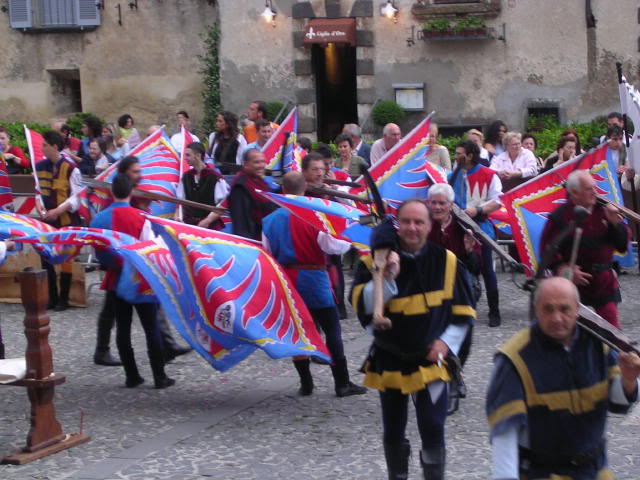
As I walked through the winding streets the evening before the festivities, the whole city seemed to be out in full force. The Comune erected special lights in the Piazza della Repubblica for the school children who were sitting on the cobblestone ground, constructing an infiorata (mosaic made exclusively of flowers). Everyone was working happily with their families way past midnight.  Nearby, in the Piazza del Popolo, young men practiced sbandieratori (flag-throwing) alongside a falconer training his raptor for the next day’s performance. Utility workers on ladders were installing speakers hidden behind sprays of flowers tied with ribbon on the main route of the procession. The solemn mass would be broadcast throughout town (perhaps so that the elderly and house-bound were not left out). The energy was electric and I could feel thta something very special was about to happen.

La Storia di Duomo

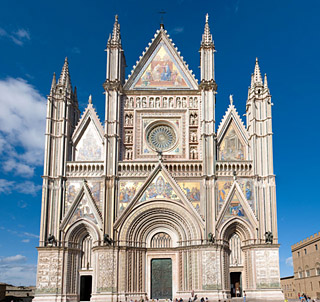
If you’ve ever been to Orvieto, you know it’s home to one of the most spectacular Duomos (Cathedrals) in all of Italy. At first glance, I remember thinking, “How did such a small town manage to build such a magnificent Duomo?” Its beauty and grandeur rivals that of the Duomos of Siena and Florence. Well, in order to build this Duomo it took a miracle: Il Miracolo di Bolsena (The Miracle of Bolsena) to be exact.

A Eucharistic Miracle: Corporal of Bolsena

In 1263, Peter of Prague, a priest on a pilgrimage to Rome, stopped at the tomb of St. Christina in Bolsena to celebrate mass. It’s said that he doubted Christ was actually present in the consecrated host, but became convinced when, during the consecration, blood began seeping from the host and trickled onto the altar and corporal. The priest immediately brought the bloodied linen to nearby Orvieto where Pope Urban IV was residing. In August of 1264, by way of a papal bull, Pope Urban IV instituted the feast of Corpus Domini and under his orders the Cathedral of Orvieto was constructed to commemorate and provide a home for the miraculous relic. It’s where it remains enshrined and exhibited today. In 1964, at the 700th anniversary of the institution of the feast, Pope Paul VI arrived in Orvieto by helicopter (the first Pope in history to use this means of transportation) and celebrated mass at the alter where the holy corporal is kept.

Homage to the Past

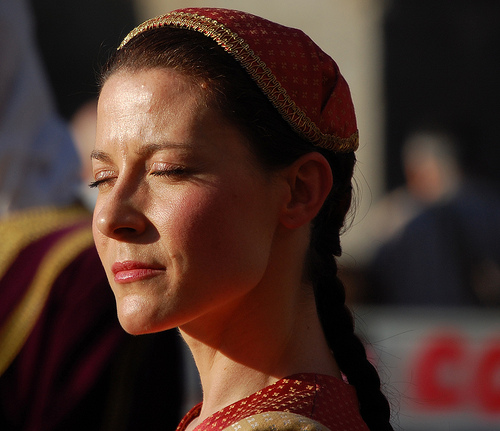
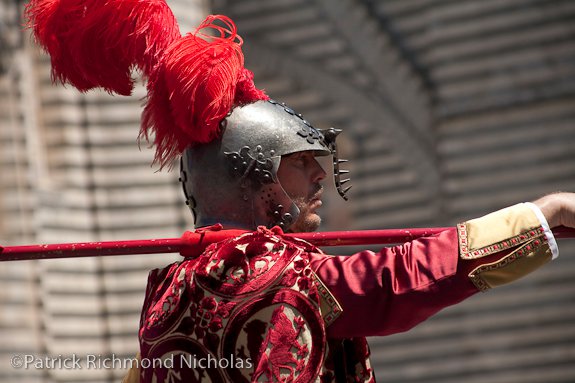
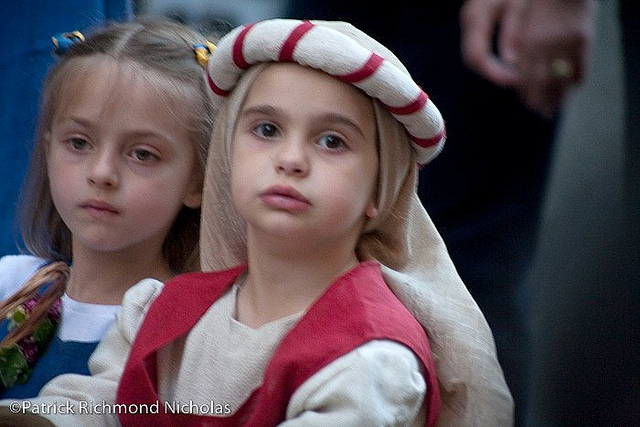
Naomi1There are faces of people that I know very well walking in this parade, but when dressed in their historical and graceful garb, they become almost unrecognizable. So authentic is their portrayal that I’m completely entranced and transported to Orvieto‘s medieval and Renaissance past. Over 400 costumes represent all the municipal courts of the time. You see coats of arms from noble families, brightly colored flags and costumes symbolic of their social or political position and metal shields, armor, weapons, helmets all signifying Orvieto‘s military strength of the era.

Man in the Mirror

A friend tells me how he came to be part of the tradition of the Corteo Storico. It began for him when he was just a young boy in school. He was selected to be part of the procession – a great honor. Each year that he participated, he was rewarded with a more prominent position the following year. Now a grown man, he fulfills a respected role as a knight and is also one of the pageant’s main organizers.

I think that one of the qualities that draws me to Italy time and again is its reverence and adoration for the traditions and folklore that are passed down to each generation. Corteo Storico is a supreme example of this commitment to its for-bearers. It’s widely believed that an important part of the present is to honor the past and those who came before. When one is dressed in his evocative and dazzling, handcrafted costume does he see in the mirror the life of his ancestor reflected back to him? I’d like to think so.

La Futura


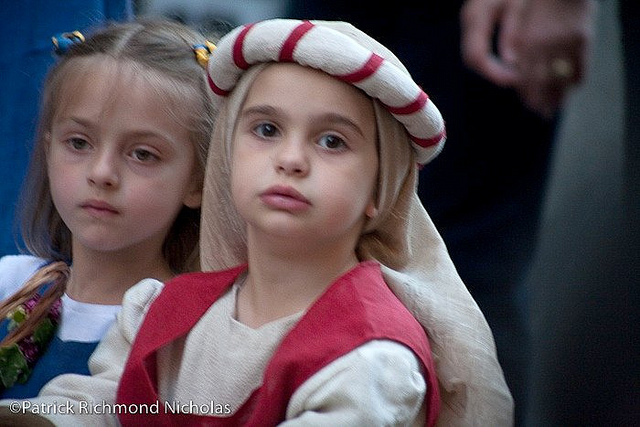
You can only imagine that some of these young children today, just beginning their experience as members of the Corteo, will one day pass this tradition onto their children and grandchildren.  They will build upon the collective memory of their medieval and maybe even their Etruscan roots thousands of years ago. Another friend of mine, Giorgio, returns to his hometown each summer to join with his childhood friends in the Corteo. It must be as important a ritual for Giorgio and his family as it is for Orvieto as a community. He is helping to keep the historical chain unbroken.

PROGRAMMA DI CORPUS DOMINI 2011 (PROGRAM OF CORPUS CHRISTI)

Friday, June 24 at 9:00 p.m.

Concert of medieval music and dance performance by Damcamus and

the choir Vox et Jubilum in the Church of San Andrea

Corteo delle Dame (Procession of the Dame)

Saturday, June 25

5:30 p.m Vespers in the Cathedral

6:00 p.m. Flag-waving by Amelia in Piazza Duomo

Corteo Storico

Sunday, June 26

10:00 a.m. Parade exits from the Palazzo del Capitano del Popolo

10:30 a.m. Procession exits from the Cathedral and continues through town

Saturday and Sunday Medieval Market in the Piazza della Repubblica.

Photographs by Patrick Richmond Nicholas and Giorgio Campanari
by Toni DeBella

Read Full Post »

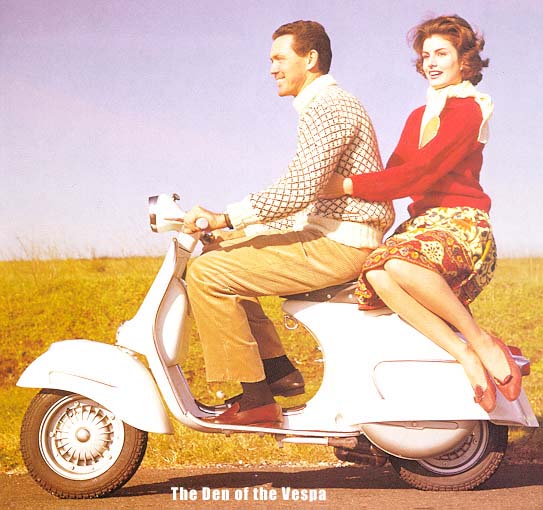
She couldn’t have been more than 18 or 19 years old. She pulled up on her Vespa alongside my cab on a warm night in Rome. She turned to her right, held her cigarette to her mouth, leaned over and without uttering a single word, the cabdriver reached out and lit her cigarette. She threw out an unenthusiastic “grazie” and drove away. I was stunned and astonished. How did this ragazza, at such a young age, manage to display such bravata?  The confidence and sheer audacity of it! She expected this man to perform on cue and he didn’t disappoint. It was a one-act play and each person had their role and they played it to perfection. More to the point, they played it with style. Romans can make even smoking look sexy!

The dictionary defines “Style” as: 1. a quality of imagination and individuality expressed in one’s actions and tastes; 2. a comfortable and elegant mode of existence; 3. a particular, distinctive, or characteristic mode of action or manner of acting.

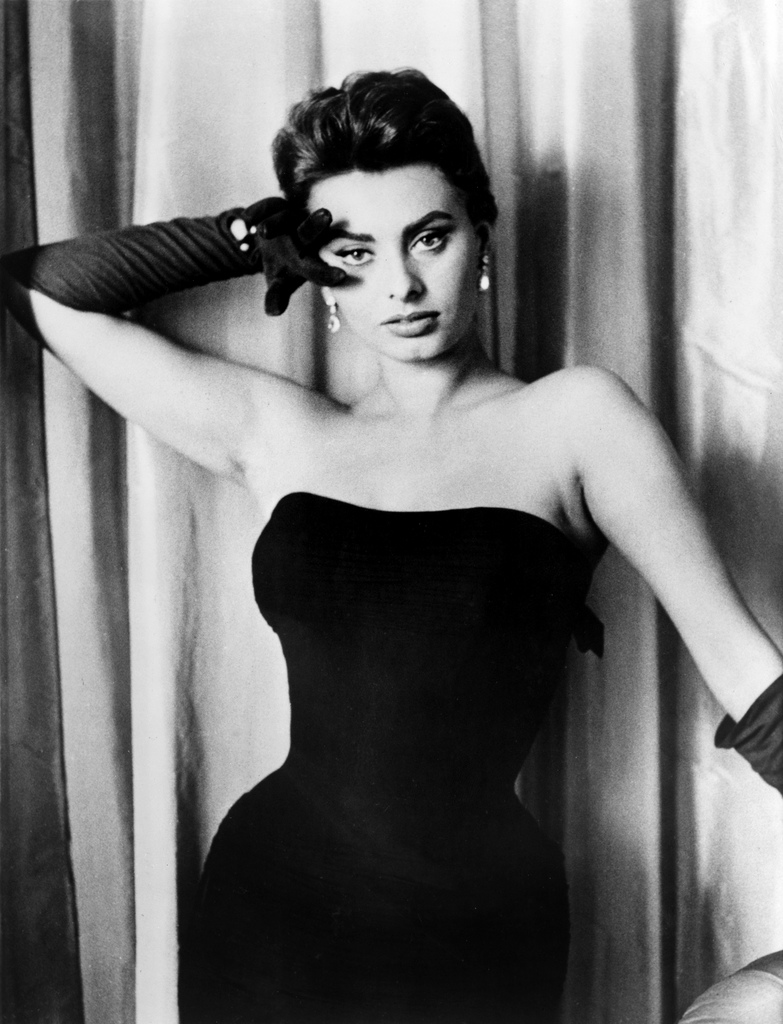
Sophia Loren

When we hear the phrase “Italian styling” what does this conger up in our minds? Elegant lines of a Maserati, a certain cut of a man’s suit, sleek and contemporary furnishings, police and carabinieri uniforms designed by Armani, ditch-diggers who look like Gucci models, and Sophia Lorens pushing baby carriages in stiletto heals on ancient cobblestones. It seems incomprehensible that these beautiful women could be as insecure and self-conscious as the rest of us, but it doesn’t matter – Italian women project a belief they are fabulous and deserving of adoration. I buy it, and more importantly, men buy it.  As far as I am concerned, that kind of confidence is the epitome of style.

A Beautiful Obsession

For Italians the term “la bella figura” is not just a saying, it’s a way of life.  My friend claims that an Italian would spend his very last dime for a pair of Dolce & Gabbana jeans before he’d pay his rent. I think that’s a bit of an exaggeration, however it certainly appears that being attractive is obligatory in Italy.  Bebbe Severgnini, the famous columnist and chronicler of the Italian psyche explains it this way, “ ‘Never judge a book by its cover’ sounds like an oversimplification in Italian. We judge books by their covers, politicians by their smiles, professionals by their offices, secretaries by their posture, table lamps by their design, cars by their styling, and people by their title.”

Italian Actor Raoul Bova

My mother, Nancy, came for a visit and we took the train to Rome for the afternoon.  We were strolling near the Piazza Barberini and walking towards us was a classically handsome Roman: tall, dark, curly-haired, chiseled features – you know, your basic Raoul Bova type. After he’d passed, my cute, lively, 78 year old mother turned to me and said, “that was a pretty one”!  Yes, they are “pretty” but being good-looking doesn’t, in itself, translate into “elegant”, “cool” or “stylish”.  A piece of art, for instance, doesn’t move you only by its beauty.  It also must tell a story, evoke an emotion and display depth and dimension.  Italian style: behind those beautiful covers is a lot of life and feeling.  When admiring an Italian’s aesthetic superiority, it’s hard to look away.  And it’s okay to look, in fact, it’s the national pastime of Italy.
by Toni DeBella

Read Full Post »

I Nonni DeBella

I used to make the same mistake most Italian Americans make. When someone asked my nationality I always responded “I’m Italian.”  It was when I moved to Italy and became immersed in its culture that I began to detect the distinct differences between us: Italians vs. Italian Americans.  We are cousins for sure – we share ancestors, history, traditions and certain sensibilities, but we are also completely different.  It comes down to that aged-old question: nature of nurture?  Nationality: I believe it’s in our DNA.

Sono italo americana

Many Italian Americans grow up in an environment that is quintessentially American but with undertones of Italian culture threaded through everything.  Mine, I think, is typical of a lot of first and second generation families whose descendants immigrated from Italy in the late 1800s to early 1900s.  My Sicilian grandparents, Gioachino DiBella and Nimfa Pizzo, were born in small towns near Palermo, and although they were very young children when they left their homeland, they remained “from the old country” their entire lives.  The photo at the top, for example, was taken in our backyard in San Jose, California around 1965.  At the time bell bottoms and the Beatles were in fashion, but looking at my grandparents in this photo, it could have been taken in 1865!

Born in America: Parts from Italy

My parents Luke and Nancy

I would say that Italian Americans are born with an identity crisis.  We are “hybrids” – the Prius’ of American society. We feel part of a culture and experience that is in stark contrast to the Ward and June Clever-types portrayed in TV sitcoms.  Our large, loud and chaotic families are the center of our universe.  At birthdays, Baptisms, Christmas, etc., the house is filled with people from the same gene pool.  Sunday dinner is served at 1:00 p.m. at our grandparents’ house (who live with us, next door to us, or down the street from us).  Thanksgiving dinner includes the traditional turkey, stuffing, yams and homemade ravioli.  Italian American friends never call – they just stop by after dinner, often bearing brown paper bags filled with cherries, zucchini, tomatoes…whatever they have in abundance from their trees or in their gardens.

Il Segreto: The Secret

I can’t really list for you all the differences between Italians from Italy and Italian Americans, I just know we are different.  I try to resist the urge to boil people down to stereotypes because it’s never useful and not quite that simple.  However, when I am surrounded by Italians, I can feel it.  It’s like they know something that I don’t know.  It’s in their eyes, in the way they carry themselves, a sort of special grin that says to me “I have the secret” to: 1) happiness, 2) living well, 3) the meaning of life.  Italians are a fascinating composite of intelligence, cynicism, superstition, generosity, warmth, hyper-criticism, style, emotionality and humanism. You certainly have to consider that their civilization has been in existence for thousands of years.  It’s a culture of people who have seen it all, done it all and have the T-shirt. Americans are the “teenagers” of civilizations – we have a lot to learn.  We may be the most powerful country in the free world, but we are “cultural pipsqueaks” in comparison.

“Families are like fudge – mostly sweet with a few nuts.” ~Author Unknown

A family camping trip

Despite all our differences, when it comes down to it, what makes us most alike – two separate people from two different countries – is our regard for family.  Family is the cornerstone of our lives: we hold it in highest esteem – even if we don’t understand each other, fight with one another, or at times hate each other.  We never forget that home and family is where we started. And if we are lucky to have been born into a good and loving one, we hope it is where we will be in the end.  So, here’s to the family…”Alla Famiglia”. That’s Italian and Italian American.

by Toni DeBella

Read Full Post »

“I do believe they are out there, guardian angels, soul mates…eager to share with us a portion of our travel. Don’t you believe there are circumstances that determine the situations, our thoughts that shape life? I don’t remember who said: “When the student is ready the teacher comes”. I think we are like a sort of antenna, able to send and receive messages at a specific frequency. There will always be someone who catches our requests and they certainly come to help us open a new door to the vastness of our soul. You have the answer in that sense of peace warming up your heart.”  

               – Antonio, in a letter dated July 11, 2010.

I’d heard about a website where you could find mother-tongue (madre lingua) speakers with whom to practice Italian, and in turn, they could practice their English with you.  By establishing a line to an Italian pen pal (un amico di penna), might I narrow the gap and feel a little bit closer to the country I love?  I registered under my il nome italiano (Italian name) Antonella and waited for the responses.

Several days passed when I received a lovely introduction letter from Antonio, a marketing executive.  He wanted to improve his English for work.  He was obviously intelligent and serious-minded, so I wrote him back..and it begins.

Antonio writes that he was born and raised in the north of Tuscany, not far from the Ligurian and Tuscan Coasts.   He is married and has a daughter at university, is a veracious reader, an avid swimmer, and sometimes, while on his frequent business trips around Europe, a painter of landscapes.

Antonio’s letters were always introspective and soulful – they touched me deeply.  Despite the language, culture and distance that separated us, we seemed to see life from similar points of view.  In less than a month we were writing long letters to each other – mine in Italian, his in English.  With each letter we revealed a little more of ourselves (he referred to it as “loosening the knots”).  We wrote of things that we couldn’t say to our closest friends and shared times in our lives that were difficult or profound.  I felt safe to express myself without concern of judgment or criticism.  We had little to lose because, in essence, we were strangers – black letters on a white computer screen.  We called what we had created between us “il nostro angolo” (our corner) – a special place where we could be our best selves.

It was springtime and I was back in Umbria at the same time Antonio was in Rome for business, so we arranged to meet for a coffee on his way home.  For both of us the Duomo of Orvieto is a very symbolic and mystical place, so we agreed that in front of its beautiful facade was a perfect meeting point.  I’d seen a photo of him a month before, but photographs never accurately portray a person’s “presence”.  Antonio strikes a beautiful figure – tall, lean and handsome.  He wore his white hair a bit long (as many Italian men do) and his glasses highlighted his blue eyes that were so bright a color, they were somewhat distracting.  He explained he must be back in Tuscany by dinnertime and had only two hours to spend with me. It was a warm and sunny day, so we decided to walk around the narrow streets of town and talk.

Those two hours passed as if they were two minutes.  The time together was so comfortable, quiet, familiar…so perfectly normal.  It seemed more like a long-awaited reunion than a first-time meeting.  After circling town, we returned to the spot where we started and sat down on the Duomo steps.  The silence between us was deafening, but neither of us knew what words to say. He finally broke the spell when he announced it was time for him to go.  We walked back to his car arm and arm, we said our goodbyes, promised to write soon, hugged and I turned and walked away. It was the last time I saw Antonio.

Throughout the year there have been occasional short notes to one another, but really, what is the point?  We both know that nothing good can come from our continued contact and although I didn’t want to let it go, the right thing to do was to stop our correspondence.  Antonio said his life is like a gypsy’s and he once wrote this about it: “Sometimes I figure that this life is driving me slowly but constantly and directly towards my dark night”.  I think about Antonio often.  I miss our conversations and wonder where in the world he might be.  But like a little jewel, the memory of that day is stored preciously in a little box in that little “corner” that we shared.


by Toni DeBella

Read Full Post »

I am standing there completely paralyzed, sweat is forming on my brow. I can feel my heart racing and I’m not sure which direction to go or who I can call to for help. I want to turn and run but the crowd behind me is pushing me forward. I feel trapped, scared, confused, disoriented…I don’t know what to do…

…Do I pay first and then order? Or, do I order, go back to the cashier, pay and then give my receipt to the barista? If I order first and want to sit down at a table, do I wait for my coffee at the counter and then carry it  there myself or order and then expect the barista to bring it to me and pay on my way out?

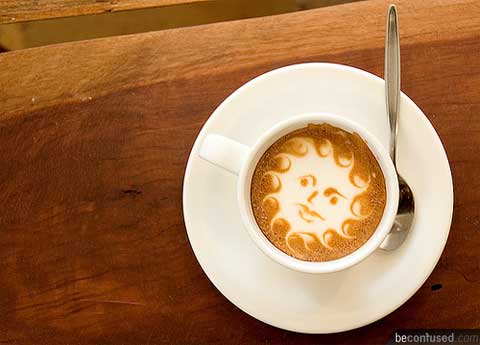
The Italian Coffee Bar: an institution, a meeting place, a culture unto itself and a complete enigma! As far as I can tell, there are no hard and fast rules – kind of like irregular Italian verbs – you can’t always get an explanation of when to apply them.  It’s intuitive – a subtle sense that develops over time and with a lot of “trial and error”.  In my case, mostly “error”.  Why on earth can’t I figure this out? I mean, I am reasonably intelligent – I went to college for God’s sake!  I can certainly manage to order a coffee in Italy. How hard can it be? Well… apparently pretty hard.

Here is a short list of coffee drinks you can order at a neighborhood Italian bar: Caffe’ (espresso), Caffe’ Americano (watered-down espresso in a large cup), Cappuccino (espresso with steam milk on top), Caffe’ Corretto (espresso with a shot of liquor), Caffe’ Freddo (espresso cold), Hag (decaf espresso), Caffe’ Latte (half espresso, half steamed milk), Caffe’ Lungo (espresso made with more hot water), Macchiato (espresso with a dollop of cream – hot or cold), Caffe’ Ristretto (stronger espresso), Shakerato (espresso, milk, sugar, and ice, shaken), Caffe D’Orzo (espresso made with barley), and Cioccolata Calda (hot chocolate)…just to name a few.  See, easy.

Until I am fully versed in coffee protocol, I have found a way to cope with my incompetency and the stress that comes with it:  I limit myself to a couple of bars in town that I am familiar and comfortable with. At Caffe’ Del Corso and Blue Bar in Orvieto, I know the owners, they know me and their system is clear (and they give me the locals’ price). Honestly, I can’t bear to see one more barista’s look of disgust when I break the cardinal rule of Italian coffee-taking; ordering a cappuccino after 11:00 a.m!

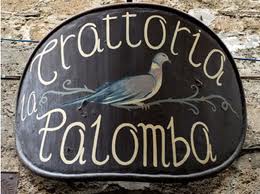
At restaurants, I used to pretend that I actually wanted an espresso after dinner because I knew the waiter would glare at me and judge me if I asked for anything more than a macchiato (espresso with a dollop of cream). In the case of Giampiero, owner of La Palomba, every time I order a cappuccino after dinner, he gives me a hard time. We have long discussions (arguments really) about why I shouldn’t have milk late at night. (Italians believe its not good for digestion).  When I ask an Italian why it’s okay to eat Panna Cotta or Tiramisu after a meal (both made with heavy cream), but not drink coffee with milk, I never get a straight answer. As far as I can tell the explanation is “you just don’t, punto! And with Giampiero, it has become a running joke, a comedy routine like “Who’s on First”. I eventually get what I want, but I have to practically beg him. Then he just shrugs his shoulders, smiles and a cappuccino arrives at my table. But you know, it’s worth all the pain and suffering because, in the end, I get to drink coffee as smooth and delicious as any in the world. Italians love their coffee and so do I!

Brothers Mirko and Cristian Galanello will offer you coffee, cocktails and soccer matches at Caffe’ del Corso, Corso Cavour 158, 05018 Orvieto, 0763 344724; Anthony and Romina make you feel very welcomed whether you are a local or a tourist at Blue Bar, Via Garibaldi, 23, 05018 Orvieto, 0763 344150; Dine on classic Umbrian cuisine and wine at La Palomba, Via Cipriano Menente, 16, 05018 Orvieto, 0763 343395. Tell owner Giampiero that “Silvia” sent you (an inside joke between us) and after a wonderful meal, order un caffe’!

by Toni DeBella

Read Full Post »

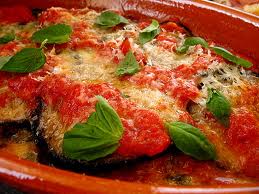
AnnaMaria arrived in Agrigento yesterday and I received an email from her to say that her apartment was beautiful but that she was dead tired. I know just how she feels. It’s probably the way I feel each time I land in Rome – it feels like home. She and I met in 2009, just after I returned from my winter living in Orvieto. I was feeling completely lost and disconnected – not adjusting well to the reentry into American life. She is the antithesis of me: dark, slim, dignified and subdued (albeit with a biting wit and sarcastic sense of humor that she reveals only when she knows you well). What we have most in common is that we know where we really belong –Italy. Me in Umbria, she in Sicilia. We know that one day we will become permanent residents of this wild, crazy and spectacularly beautiful place. This we know for sure. It was such a lovely and warm evening in San Francisco, so after work I decided to treat myself to a nice dinner in her honor. I strolled up and down Union Street and stopped in front of Pane E Vino Trattoria. Through the window I could see they had a few small tables near the front where there is light so I could read my book. (I always have to bring something to do in case I get self-conscious about dining alone). The proprietor is Italian, all the waiters are Italian, the elderly couple next to me were Italian, the older couple on the other side of them were Italian (he immigrated to San Francisco in 1948 – I was eavesdropping). I recognized a guy from Milano I’d met a few times at my Italian conversation meet-up. I spoke to my Venetian waiter in Italian, but first I apologized for my sub-standard skills. Like most Italians, he was kind and said “No, no, you speak very well, Bella”. Gotta love those Italians! I sat there eating my delicious Melanzane alla Parmigiana and a perfectly grilled side of asparagus with a glass of Chianti, just listening to everyone around me speaking Italian. Couples, families, a man and his mother. I noticed on the wall above me a ceramic sculpture of the moon and sun. It made me think of my artist-friend who sculpts versions of this symbol in terracotta. That’s when I felt the tears well-up in my eyes. It’s not sadness, exactly, but not really nostalgia either. It’s hard to describe, but it always catches me off-guard. I’ve been back from my last trip for almost a month and thought I was past the culture-shock and let-down that grips me. I thought I was doing okay, but I guess I was deluded. Walking to my car, I thought about AnnaMaria again. Not one-single ounce of my being is jealous of her right now. On the contrary, I’m happy for her, proud of her, admire her for taking the leap-of-faith and going to Sicily for 2 months. I know what it takes to do that – the confidence to know what makes you happy and the courage to try to obtain it. I want for her what I want for myself; to find a way to stay in Italia forever. Complimenti, AnnaMaria!!! by Toni DeBella

Read Full Post »

« Newer Posts