Feeds:
Posts
Comments

Archive for the ‘Italy’ Category

For years young lovers have come to Il Ponte Milvio (Mulvian Bridge) in the north of Rome to declare their undying affection by writing their names on a lock, attaching it to a lamppost on the bridge and then throwing the key into the Fiume di Tevere (Tiber River) below. It’s a iron-clad promise to love each other until the end of time. Eternity ain’t what it used to be!

The bridge started attracting sweethearts after the publishing of Federico Moccia‘s popular book and film ““Ho Voglia di Te” (“I Want You”) in 2006.  Unfortunately the barrage of locks started to bend the lampposts and the practice had to be limited to steel posts added by the Mayor. When the posts become filled, the locks must be removed to make room for newly-passionate visitors.

Perhaps it’s a sign of the times? Along with the City’s reasonable attempt to keep its infrastructure from crumbling under the weight of thousands of metal locks, the solution perhaps mirrors the devotion and commitment of modern couples these days. Happily ever after is hard to come by and having your declaration to the one you adore chopped-off by an orange suited city worker with a wire cutter seems to underscore the changing landscape of amore a Roma.

But being the hopeless romantic that I am, I like to imagine that someday an old couple will walk arm-and-arm across the Ponte Milvio and recall when they too placed a lock on this bridge to commemorate the beginning of their love story. They’ll smile because they’ll know that love can last even when the symbol of that love has long gone.


by Toni DeBella

Read Full Post »

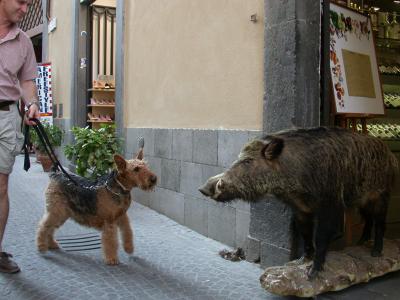
He keeps company with movie stars, famous athletes, powerful politicians and royalty. Children love him but dogs are a little intimidated by his strength and confidence. He’s very charming and blessed with a certain “savoir faire” that draws beautiful women to him – they vie for a chance to stand next to him, but he prefers that they not muss his hair. He is always gracious, if not just a bit aloof.  He tries never to refuse an admirer’s request to take a photograph with him because he doesn’t want to disappoint or appear snobbish. His reputation precedes him. He is the most recognized, popular and interesting man in Orvieto.

Il cinghiale” (the boar) holds court everyday outside Carraro, C. Cavour 101 (☎0763 34 28 70; carraro@orvieto.tin.it), just a few meters down the Corso from where the Via Del Duomo intersects with the Torre del Morro.

Dog v. Boar – Photographed by A. Teich; http://www.pbase.com/al309/italy

Photo of Viola and Paloma by Linda Martinez


by Toni DeBella

Read Full Post »

The letter from the Consolato Generale D’Italia a San Francisco arrived in the mail today. The words inside the envelope were a culmination of three long years of hard work and dogged determination: 31/08/11 Dear Ms. DeBella: “I am pleased to notify you that your Italian citizenship has been recognized and that your certificate(s) have been forwarded to the Italian municipality of CORLEONE (PA) for recording.”

Somehow I envisioned this auspicious occasion much differently. There were times when I wondered if this day would ever come. And if it did arrive, I imagined it would be filled with much fanfare, jumping up and down, and screaming. Instead it was a quiet moment. A solitary moment. A very personal moment. It was a time to reflect on what it took for me to get to this place: Patience, tenacity, belief, humor, and a clear intention. August 31, 2011 is the day I became a citizen of Italy.

Italian by Blood Jure sanguinis (“right of blood”) contrasts with jus soli (Latin: “right of soil”) in that citizenship is not determined by place of birth, but rather by having a parent (or decendent) who is a citizen of a nation. In Italy there’s no limit to the generations that can obtain citizenship via blood (except for specific constraints which did not apply to me). Furthermore, because the U.S. and Italy have a reciprocity agreement, one is allowed dual citizenship.

After tracking down my grandparents’ birth certificates (likely located in books archived in church basements of Corleone and Contessa Entellina), respectively, I gathered together some twenty other documents (i.e., birth, death, divorce) for both myself and members of my immediate family. Translations and Apostilles followed, along with a list of discrepancies and misspelled names (of which there were many). And don’t even get me started on the rabbit hole that is the U.S. Department of Homeland Security! This part  of the process took a little over a year to complete. Then there was the waiting period (one-and-a half years, to be exact) for an appointment to personally submit my application to the Italian Consulate.

The procedure was daunting, frustrating, and at times discouraging. When I felt like giving up, I thought about the finish line — life in Italy — which helped to spur me on. I suppose that if becoming a citizen of a country were easy, everyone would do it. You really have to want it!

The Gift

I Nonni DeBella, San Jose, California

Throughout these three years I’ve been fortunate to have the support and encouragement of friends and family, both in the U.S. and Italy. But it was my grandparents, Jake (Gioachino) DiBella and Emma (Ninfa) Pizzo, who deserve my utmost thanks and gratitude for without them none of this would be possible. In the late 1880s, they came to this country as young immigrants from Sicily. They married, worked hard, and raised a family of ten children. I wonder what they would have thought about their granddaughter one day returning to the land they left behind.

It appears that the DeBella family, in the not-too-distant future, is about to come full circle.

by Toni DeBella

Read Full Post »

I have never been overly-superstitious and take great pride in my healthy cynicism.   I don’t throw salt over my shoulder or avoid black cats.  As a muralist, I walk under ladders frequently and don’t believe I have ever fallen victim to the evil eye.  Thinking or saying something out loud does not make it come true.  If it did, I’d be a size 6, rich and living in a palazzo in Orvieto.  But I digress.

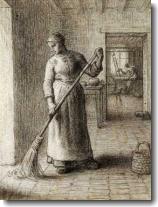
My grandmother was normally a very serious and solemn woman.  One day a year she would transform into a madwoman, wielding a broom and running in circles shouting and screaming like a banshee in an effort to ward off the evil spirits who had apparently taken up residence in our cellar.  It was spring cleaning run amok.  I don’t know much about the tradition that had this small, fragile and shy lady fearlessly take on a bunch of ghosts in the basement of our house.  I wonder if it was folklore passed down from her childhood in Contessa Entellina, a small Sicilian town 80km from Palermo.  I did a little research and found quite a few references to sweeping away evil spirits with a broom — a common practice especially among southern Italians, but was unable to find any mention of the “screaming and running around” part.  Perhaps that was my grandmother’s own personal stamp on the custom.

Superstitious Minds

A superstition is a belief in something that has no rational foundation in science and is most often based on the prevailing religion or culture that contains these otherworldly beliefs.  The word comes from the classical Latin superstitio, meaning “a standing over [in amazement]”.  Greek and Roman pagans were believed to have scorned men who displayed a fear of the gods and thus, the behavior came to be referred to as superstition. This could explain why Greeks and Italians are famously known for their mythology and have a common legend in the “evil eye” – Malocchio in Italian, Mati in Greek.

Hope-On-A-Rope

When I wrote earlier that I am not particularly superstitious, I wasn’t being completely honest with you.  The fact is that in the last few years I have come to believe a certain necklace I own has developed supernatural powers that, if worn daily, will someday bring me good luck.

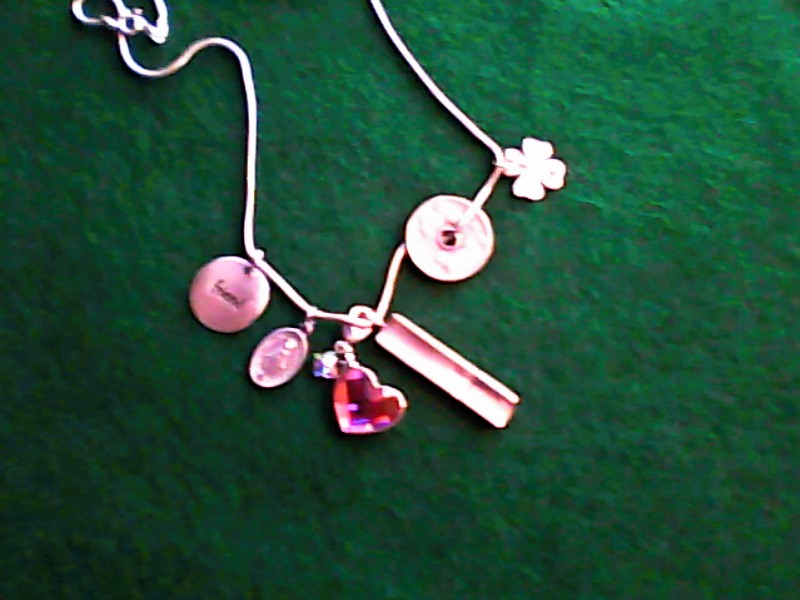
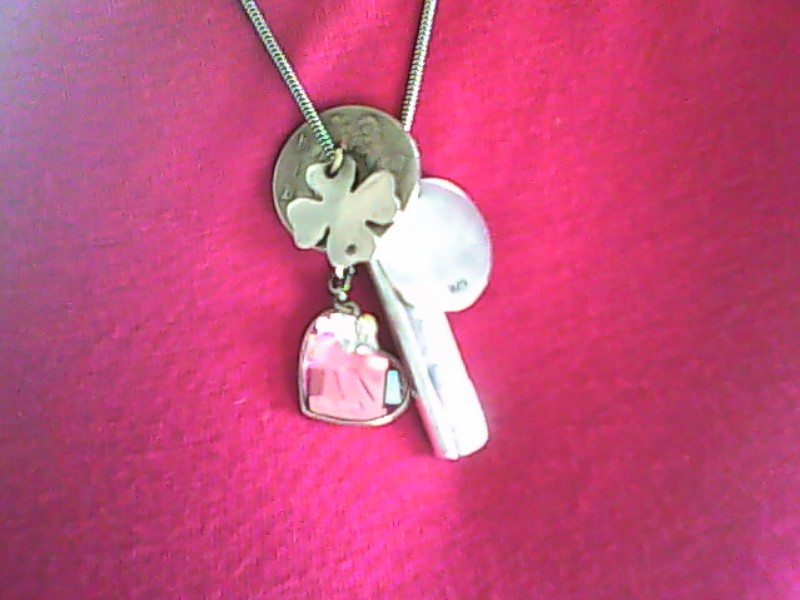
It started out as a simple chain with a silver bar hanging from it.  One afternoon while in St. Peter’s Square I looked down to see something glittering in the sun.  I removed it from between the cobblestones to discover it was a tiny medallion of the Madonna.  Convinced this was an omen, I instinctively hung it onto my necklace.  A birthday present of a charm with the word “Friend” engraved on it followed — then a Chinese coin and a 4-leaf clover.  On one arrival in Rome I wrote the message to my friend Angelo, “Io sono in Italia…mi sento come una farfalla” (I am in Italy…I feel like a butterfly).  When he presented me with the gift of a tiny crystal butterfly dangling from a pink heart of course I had to add it to my collection.  This “chain of fortune” is getting rather heavy!

Out of the 365 days in a year, I probably wear the necklace 360 of them.  The other 5 days I just don’t feel quite right without it.  Could I have inherited from Grandma this propensity to make weak associations of cause and effect where there are none?  What can I say? I don’t like tempting fate.  Writer Judith Viorst said it very well: “Superstition is foolish, childish, primitive and irrational — but how much does it cost you to knock on wood?”
by Toni DeBella

Read Full Post »

A picture is a poem without words.” -Horace

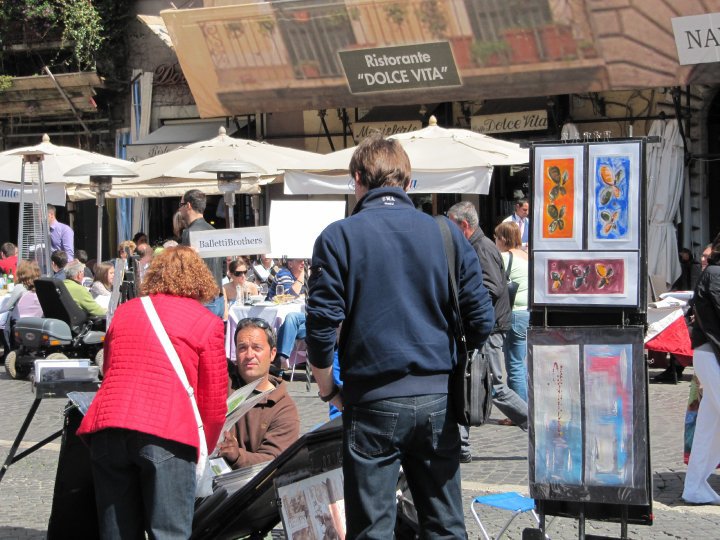
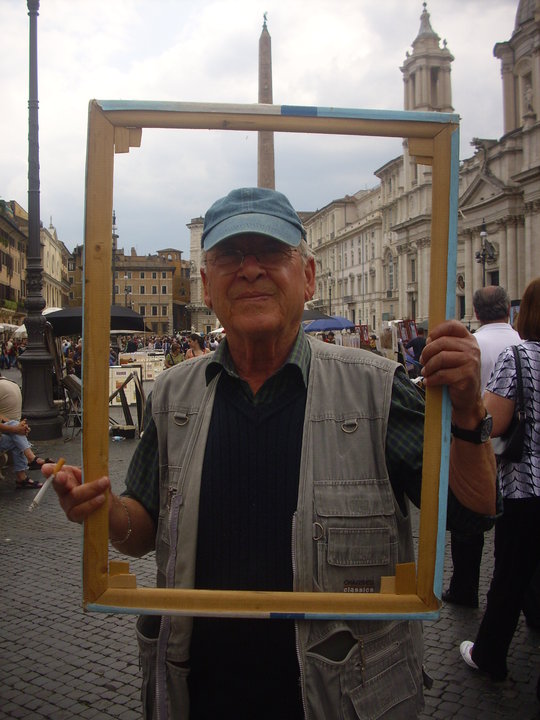
A revolution has been brewing for almost a decade on the Piazza Navona, one of the most famous and historic squares in Europe. Millions arrive to see Bernini’s magnificent Fontana dei Quattro Fiumi (The Fountain of 4 Rivers) and to stroll along the road, hoping to acquire an original picture of a Roman scene painted and signed by the artist in front of them. Now the tensions are high: real artist are pitted against counterfeit ones.

Art is not a thing, it is a way.”- Elbert Hubbard

I can’t intelligently speak to the political or economic ramifications of the most recent decree approved by the City of Rome to regulate painters and street artists on the piazza.  What I can say with certainty is that I believe society is obligated to defend those among us who have the ability to suspend reality and, with a brush in hand, transfer it onto a canvas to make a thing more beautiful – to make l’arte. George Bernard Shaw said it best when he wrote,“Without art, the crudeness of reality would make the world unbearable.”

Performance Artist

In 2005, the Mayor and Council approved a ban prohibiting any type of commercial activity in the center of Piazza Navona. It was declared that permits would no longer be issued to paint in the city. Then came a resolution to govern the artistic profession, but nothing came of it. Nearly 6 years later the absence of rules means anyone (real artists and fakers) can enter and do what they want. The result has been a dilution of creativity and a strengthening of chaos and clutter. The legitimate are at a disadvantage to the counterfeiters who defraud tourists by peddling reproductions passed-off as originals. But why should the artists, some of whom have been on the Piazza since the 1960s, pay the price for the City’s failure to control those who bring urban decay to this beautiful place? Why should the people who have promoted all that is good about the Eternal City and have contributed to its charm and mystique now be threatened with displacement? Leonardo is turning in his grave!

No heirloom of humankind captures the past as do art and language.” – Theodore Bikel

What is at stake on the Piazza Navona is the keepsake of a city. Art has defined Italy since the renaissance and just like the oxygen in our atmosphere, civilization and Rome need it to survive.

Photographs by Toni DeBella and Massimilliano Balletti

Paintings by Massimilliano Balletti

by Toni DeBella

Read Full Post »

The opinions expressed herein are those of the author (me) and may not reflect the opinions of the reader (you). There is absolutely no assurance that any statement contained in this article is true, correct or reliable. The opinions are based solely on observation and personal experience.  The foregoing is presented from the point of view of the author (me).  …”usate il sale in zucca” (an idiom loosely translated means “take it with a grain of salt”).***

The Grass is Always Greener

2012-04-25 13.54.32I want to begin by saying that I’ve done it, you’ve done it, we’ve all done it at one time or another. We really must stop doing it: expatriates sitting around moaning and groaning about how things function (or don’t function) in Italy.  First of all, can you imagine how we must sound to Italians within ear-shot of our tasteless and unflattering belly-aching? Openly criticizing the country and people who have welcomed us into their “home” is not only impolite, it’s incredibly tacky. We made a choice to leave our native land and relocate to another, did our research and knew what to expect when we took the leap.

An analogy to illustrate my point: George Clooney has infamously left a long line of beautiful starlets in his wake. Elisabetta Canalis is out and now you are George’s new girlfriend. He is so charming, handsome, rich and powerful. You attend red carpet events on his arm in Versace, appear on the cover of People magazine and spend long weekends on Lake Como with “Brangelina”. Of course he eventually dumps you and deep-down inside you’re not surprised – this is who he is and what he does. Expats in Italy…we knew what we were getting into – Italia is who she is and what she does – let’s lighten up and stop complaining already!

We Aren’t in Kansas Anymore

It’s an exercise in futility to compare our homeland to Italy.  Italy is different – isn’t that one of the reasons we decided to pack up and move in the first place? Heinz ketchup, Mexican food, peanut butter – the list of things from home that you can’t get in Italy is as long as my arm (and vice versa, I might add).  I’m guilty, I admit it.  I’ve been a “mule” for friends – bringing  back suitcases full of taco seasoning, ranch dressing, vanilla extract and ibuprofen. Comforts from home are really lovely to have, nevertheless we should try to be more adaptable and use the products available …conform, fit in, go native!

Talking Points

This one is so obvious, I shouldn’t have to say it: speak Italian. When we live abroad of course we gravitate towards a crowd with a common culture and background. I try not to use my English-speaking friends as a crutch to avoid Italian proficiency because I know that I can never, ever form lasting and deep relationships with Italians if I don’t speak their language.  Unfortunately there is only one way to accomplish this…open our mouths and talk.  My Italian is substandard to say the least and I make errors constantly.  I once told a man that my grandfather was born in “coglione” (which means “testicles”).  We both laughed until we cried.  May I recommend the “Italian by Osmosis” system?  Watch weird Italian television, read the local newspaper, listen to pop music on the car radio, try telling a joke in Italian and above all, be willing to feel awkward and sound stupid.  Italians are very gracious and will appreciate the effort.

Home is Where the Heart Is

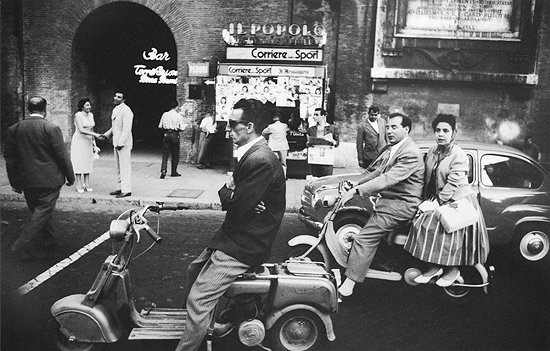
Photo by W. Klein

It seems to me that life is full of wonderful opportunities to evolve and expand our horizons.  Living abroad is something that takes a certain kind of daring individual with lots of resilience and an open heart.  Make fun of yourself and the absurdity of it all.  Relax, enjoy, grin and bear it and REJOICE…you live in Italy for God’s sake!

***No actual expatriates were harmed in the writing of this article.


by Toni DeBella

Read Full Post »

Twenty years from now you will be more disappointed by the things you didn’t do than by the ones you did do. So throw off the bowlines, sail away from the safe harbor. Catch the trade winds in your sails. Explore. Dream. Discover.” – Mark Twain

In a perfect world there would be no boundaries and we would all be citizens of the world, free to roam from place to place at our heart’s desire. Until that day comes, you’re going to need a government-issued passport.

Passport 101

King Henry V of England, most noted for his great military mind is also credited with inventing what is considered the modern version of the passport. Earlier references to the passport have also been found in the Hebrew Bible. In medieval Europe a document was required in order to pass through the gates of a city wall or traverse a territory.

American in Paris?

The latest statistic regarding the percentage of Americans (less than 30%) who own passports is a little sobering and quite frankly, a bit suspect. I disagree with the popular assumption that Americans are fundamentally unadventurous, isolation-loving people without a global perspective. I assert that the low number of passports issued is misleading and actually a reflection of many mitigating factors including: 1) The geographical make-up of the United States. It is a vast, diverse land filled with amazing places (national parks, big cities, beautiful beaches, majestic mountains, etc.,) that keep Americans sightseeing within its borders; 2) The U.S. neighbors only two other nations, unlike Europe which has nearly a total of 50 border-crossings on its continent. For example, an Austrian boards a one-hour flight or sets out on an eight-hour car trip and reaches a myriad of foreign countries. A one-hour flight from San Francisco takes me as far as Los Angeles, Las Vegas, Portland, and somewhere in the middle of the Pacific Ocean; 3) If you are a member of the working middle-class it is likely you have only two-weeks vacation a year and on top of that; 4) foreign excursions can be quite expensive.
But for those who choose to hold a passport, they hold unlimited possibilities in their hands. This tiny book has power. With it you have permission to pick-up and jet-off to strange and exotic locations at a moments notice. My son has let his passport expire and I am continually nagging him to get it renewed. “You never know when you might need to fly to Paris for lunch”, I say. He rolls his eyes. He’s right, this situation doesn’t come up too often – but it never hurts to be ready just in case. As for me, I caught the “travel bug” later in life and I caught it with a vengeance. Just recently I renewed my passport and sweated those few weeks without it. It was a relief to find it in the post safe and sound. I look forward to the next 10 years of gallivanting.
My recent passport is only the third in my lifetime. Growing up in our family meant we never ventured farther than our Ford Country Squire station wagon could take us. In college, I went to Mexico quite a few times, but back in “the day” you weren’t required to carry documents to go south or north of the border. In 1982 I took my first international flight to Sydney, Australia for a friend’s wedding and joined the prestigious group “world traveller”. Since that time I’ve been to only a handful of different countries: Mexico (twice), Costa Rica, The Bahamas, England (twice), Germany (twice) and of course, Italy (dozens of times). In two months time I will be adding France to that list. My Passport Personality: Late Bloomer.
On this ever-changing, fluid planet it is nearly impossible to maintain an accurate list of countries in the world. The Travelers’ Century Club has compiled a “Master List” of countries, territories, autonomous regions, island groups, states and provinces that theoretically make up the world. Currently there are 872 places pinpointed. No one person has visited them all, but a few have come close. My friend Marisa is in her 30s and has one of the most impressive passports I’ve ever seen. (The photo at the top is from a page in her actual passbook). She considers it among her most prized possession. She’s travelled since she was a baby and in her teens and early 20s lived many years abroad (both on land and on boats). She is now gainfully employed as a maritime attorney, so her globe-trotting has stalled a bit. But deep down inside she will always have the heart of a vagabond and wanderlust in her veins. Her Passport Personality: Marco Polo.

So, what does your passport say about you?

by Toni DeBella

Read Full Post »

February, 2009

A friend was visiting on a sunny, frigidly cold winter’s day when most people would have preferred to stay indoors and keep warm. Not us. We hopped on a bus that dropped us in Bagnoregio, then hiked up to the footbridge to the top of Civita’.

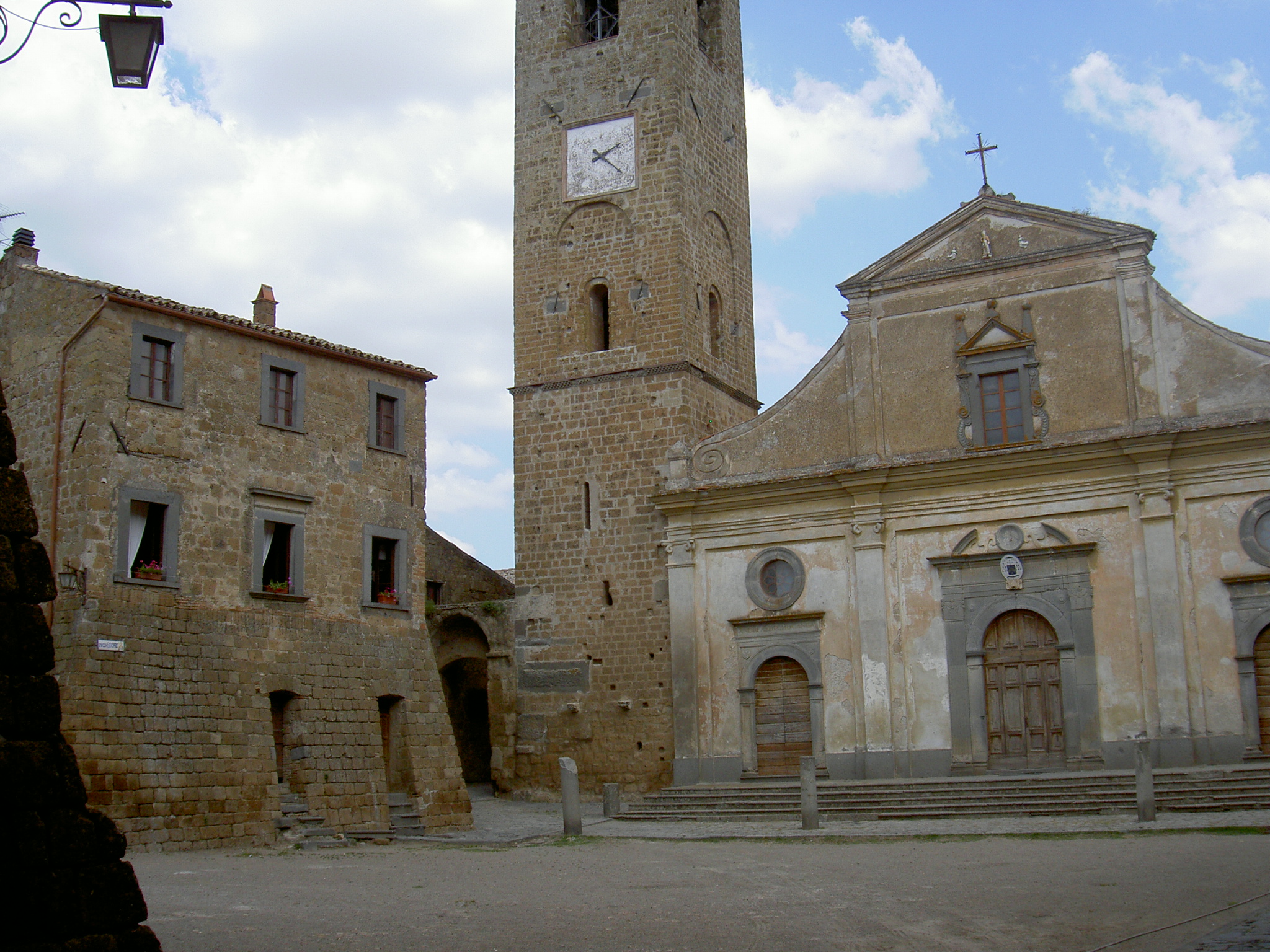
CivitaCivita’ di Bagnoregio (“the dying town”) is located 145km north of Rome in the region of Lazio, overlooking the Tiber Valley. The village seems to float above the earth in a cloud, but has the unfortunate distinction of being one of the world’s most endangered places; the town is slowly crumbling and sliding down its cliffs.

This little borgo has always had a strange allure for me (as it has, I’m sure, for millions of others who have experienced visited). The atmosphere that day was a little eerie because there didn’t appear to be any other souls in town (except  two ambling cats in the main square). It’s a favorite stop of tourists in the spring and summer, but on this February afternoon, the streets were quiet and deserted; underscoring the heartbreaking reality of the city’s inevitability. I’ve visited Civita’ three times in my life. The first was as a tourist. The second was as a dinner guest at the home of a friend (which was pretty amazing considering there are only a dozen residents remaining in this little hamlet). My last visit was by far the most memorable.

A small sign hanging in a courtyard is the only indication that there’s a thriving business inside a grotta at the end of the enchanting patio. Bruschetteria L’Antico Frantoio is too tiny to be called a cafe’, and the menu is too limited to be a restaurant – so it’s simply called a “bruschetteria”. I imagine it’s like no other bruschetteria in Italy. The Rocchi family has been operating this iconic destination of travelers for decades with its 1500 year-old olive oil mill (frantoio) in the back. The mill, which still functions (although it’s retired) has been in the family since 1520. Today, the family’s Agriturismo “Le Corone” in a valley nearby produces all of its oil.

On this day, Felice Rocchi was our host and chef. A remarkably efficient use of space, there is only a fireplace to grill the bread, a counter to assemble and serve the bruschetta and wine, and a few tables covered in tablecloths. I think we were Felice’s only customers that day and since we were in no hurry to return into the freezing wind, the three of us passed a very pleasant afternoon talking and eating the most amazing olive oil-soaked bruschetta and drinking the freshest house red wine. We chatted about Felice’s family, got a private tour of the Etruscan well in the cantina, and together devised a kooky plan to help bewildered Jtourists how and what to order. He promised us a cut of the projected profits from our little scheme, but I think when I return, I’ll ask for my share to be paid in bruschetta.


by Toni DeBella

Read Full Post »

One of my great fortunes in life is having two close friends who work as Flight Attendants for major international airlines.  These two women both collectively and single-handedly enable me to feed my addiction to Italy (or as I sometimes like to refer to it, “my crack”).  The companion fare or “buddy pass” is a way of traveling that’s not for the faint of heart.  It requires nerves of steel, the patience of Job, the imagination of Sherlock Holmes, and the ingenuity and resourcefulness of MacGyver.  It also helps to have an innate ability to build alliances and form coalitions with the other “buddies” in line for the few choice “non-revenue” seats.  It’s sort of like “Survivor”, but in an airport. Companion fares are a fraction of the cost of a regular ticket, but as the old adage goes, “You Get What You Pay For.”

Don’t misunderstand me, I am eternally grateful to my friends for sharing their privileges with me, however, if you’re planning to travel this way, you must go in with your eyes wide open and accept its cruel game of “standby roulette”.  I’ve sat many a time at the gate testing the theory that it’s possible to telepathically compel myself onto the airplane by chanting over-and-over-again, “please call my name, please call my name, please call my name” (like some twisted mantra to will the gate agent (who’s forehead I’ve just burned a hole through) to say those 7 magic words, “passenger DeBella, please come to the podium”.

Ahh, the sweet glory of nabbing a seat in business class from New York to Rome! Warm nuts, champagne, fluffy socks, a blanket made of natural fiber and, the pièce de résistance, a seat that reclines almost flat.  Once you’ve flown business class, it’s hard to return to coach.  In the back, (an airline industry term for “where the losers sit”) I feel like an immigrant crammed into steerage on the Titanic.  Should things go awry, I’m convinced any real lifesaving procedures will be afforded to the platinum American Express cardholders first.  However, I’m not thinking about that today – today I’m one of them.  The cabin crew addresses me as Ms. DeBella: “Ms. DeBella, what would you like as your entree?” “Ms. DeBella, would you like a warm towel?” “May I get you another pillow, Ms. DeBella?” They don’t call it business class for nothing.

volcano

But there’s a dark side to “standby, non-rev” (another airline term for “cheapskates who sponge-off their friends and family”).  I’ve been stranded in Milan for 3 days (my traveling companion was a high-strung, hot-tempered, not-so-easy-going Italian – very stressful!); Rome – 3 days (I finally resorted to tears and someone took pity on me); New York – 5 days (Icelandic volcano eruption – 7 million other passengers and me marooned, so I don’t really count that one).  I’ve slept overnight on a bench in a food court at Frankfurt airport, aligned with 8 other rebuffed “buddies” (we filled an entire B&B in Fumicino, Italy) and naively accepted an offer from Domenico (a complete stranger I sat next to on a flight from Hahn to Campino) to drive me to Orvieto on his way to Viterbo.  He could have been an ax-murderer, but as it turned out, he was a really lovely guy.

The bottom line is…I will take the opportunity to travel anyway I can get it.  I love airports – they’re  happy places for me.  When I’m in one, I’m either going somewhere far away or returning from a wonderful and unique adventure.  It’s certainly challenging to fly around the world without a structure or a guarantee. Honestly, I sort of enjoy the game – it feels like a test of my character and determination.  Over the years, I’ve managed to overcome a lot of obstacles, and maybe those hardships make arriving at my destinations all the more satisfying.  So, like the title of this blog implies, I will beg, borrow and steal to get where I am going.  Buon Viaggio! by Toni DeBella

Read Full Post »

Each Pentecoste Sunday for centuries, a large crowd gathers in front of the Duomo di Orvieto to celebrate the Festa della Palombella. Despite the condemnation of animal rights advocates, a dove is placed in a plexiglass “space capsule” and launched on a zip-line across the Piazza. It arrives at the specially constructed cenacle with great fanfare of fireworks, red flames and clouds of smoke. The dove symbolizes the descent of lo Spirito Santo (the Holy Spirit) on the Apostles. It’s said that if the dove survives the traumatic journey, it portends a year of good crops and fertility for the city’s most recently wed couple, who vow to care for the dove until its natural death.

Apparently, this year “la colomba” had other plans! Somehow the container had opened prematurely and amidst a cheering crowd, the dove made her daring and defiant escape – literally and figuratively – she “flew the coop”. The question remains: If a “surviving” dove signifies a year of favorable crop yields and a “deceased” dove predicts a weak harvest, then it’s good news for farmers since a liberated dove is certainly “alive and well”.

But what is the fate of the newlyweds who were deprived of their blessing of peace and fertility? I have no doubt that every bar in town is humming with speculation about this twist of fate! The discourse and theorizing could go on for the next 365 days!
by Toni DeBella

Read Full Post »

« Newer Posts - Older Posts »