Archive for the ‘Italians’ Category
Forza Azzurri…
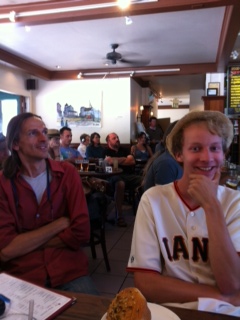
Posted in Expat in Italy, Italian Soccer, Italians, Italy, tagged European soccer championships, Forza Azzurri, Italian Soccer, Italy vs. Spain, Sausalito, travel on July 1, 2012| 5 Comments »

La Signora: Il Capo d’Italia
Posted in Expat in Italy, Italian Culture, Italians, Italy, Orvieto, Travel, tagged evil eye, Fort Knox, italian society, La Signora, Orvieto on April 1, 2012| 14 Comments »
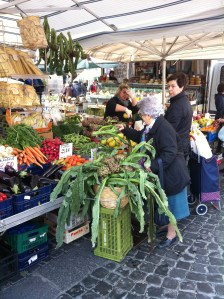 People often speak about the traditional “Signora” as if she were a charming part of Italian society long since past. Don’t you believe it! La Signora is quite alive and well and combing the streets of Orvieto in search of a naïve and insecure American like me to use for target practice to sharpen her skills of intimidation. Frankly, I live in terror of getting on the bad side of one of these ladies.
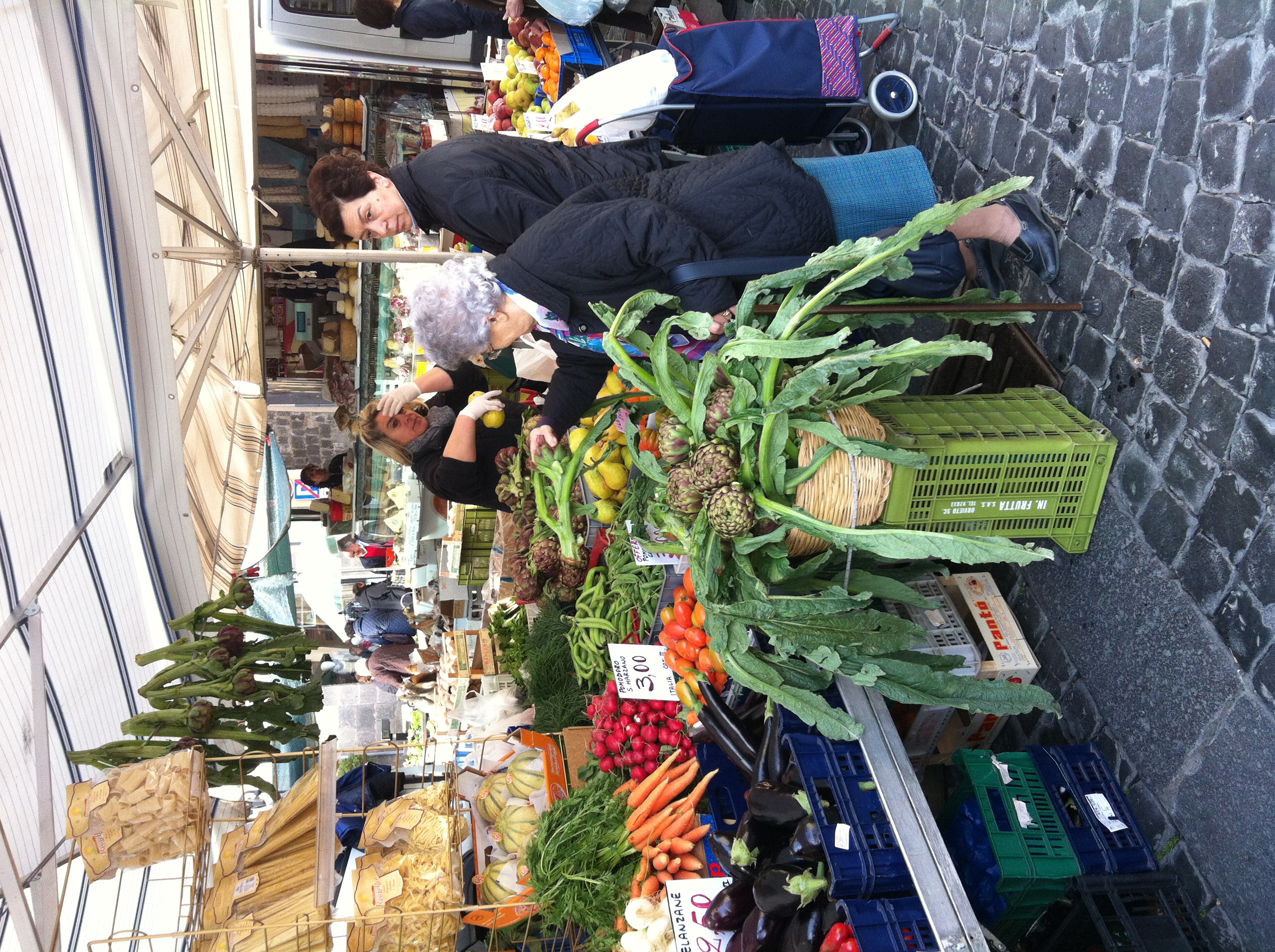
I had my first real run in with La Signora at our town’s Saturday outdoor market. I’d made the amateurish blunder of hesitating for a split second and a woman with her produce-filled cart literally ran over me, scraping the back of my heel which broke the strap of my favorite pair of sandals. She didn’t even slow down – blowing right past me without a word. She was surprisingly unaffected by the ranting and cursing of a bloodied lunatic who doesn’t know her way around a vegetable stand. I learned at that moment that La Signora, like other people of great power and influence, is a force to be reckoned with.
La Signora demands respect and she most assuredly gets it. She is a sensible shoe-wearing, evil eye-casting, mama’s boy-promoting woman on a mission. She is serious-minded, takes no prisoners and doesn’t trust you as far as she can throw you. Her outside shell is tough to penetrate – Fort Knox would be easier to crack than her personal inner sanctum.
I both admire and revere La Signora. She is able to out cook, out shop and out walk me up a hill…and if she needed to, I believe she could even out run me. In Italy, La Signora reigns supreme.
Share this:

Jazz on a Hilltop: Umbria Jazz Winter 2012
Posted in Culture, Festivals in Italy, Festivals in Umbria, Italians, Italy, Orvieto, Umbria, tagged chano dominguez, danilo rea, Funk Off, gianluca petrella, gonzalo rubalcaba, jubilee singers, Orvieto, Orvieto Cathedral. Capodanno, roman catholic mass, Umbria Jazz Winter on December 28, 2011| 2 Comments »
Watch YouTube Video Below!
Yes, I know you’ve seen this post before….but it’s Umbria Jazz Winter #20, so I’m updating the line-up and reminding everyone that there’s a 6-day party going on in Orvieto!
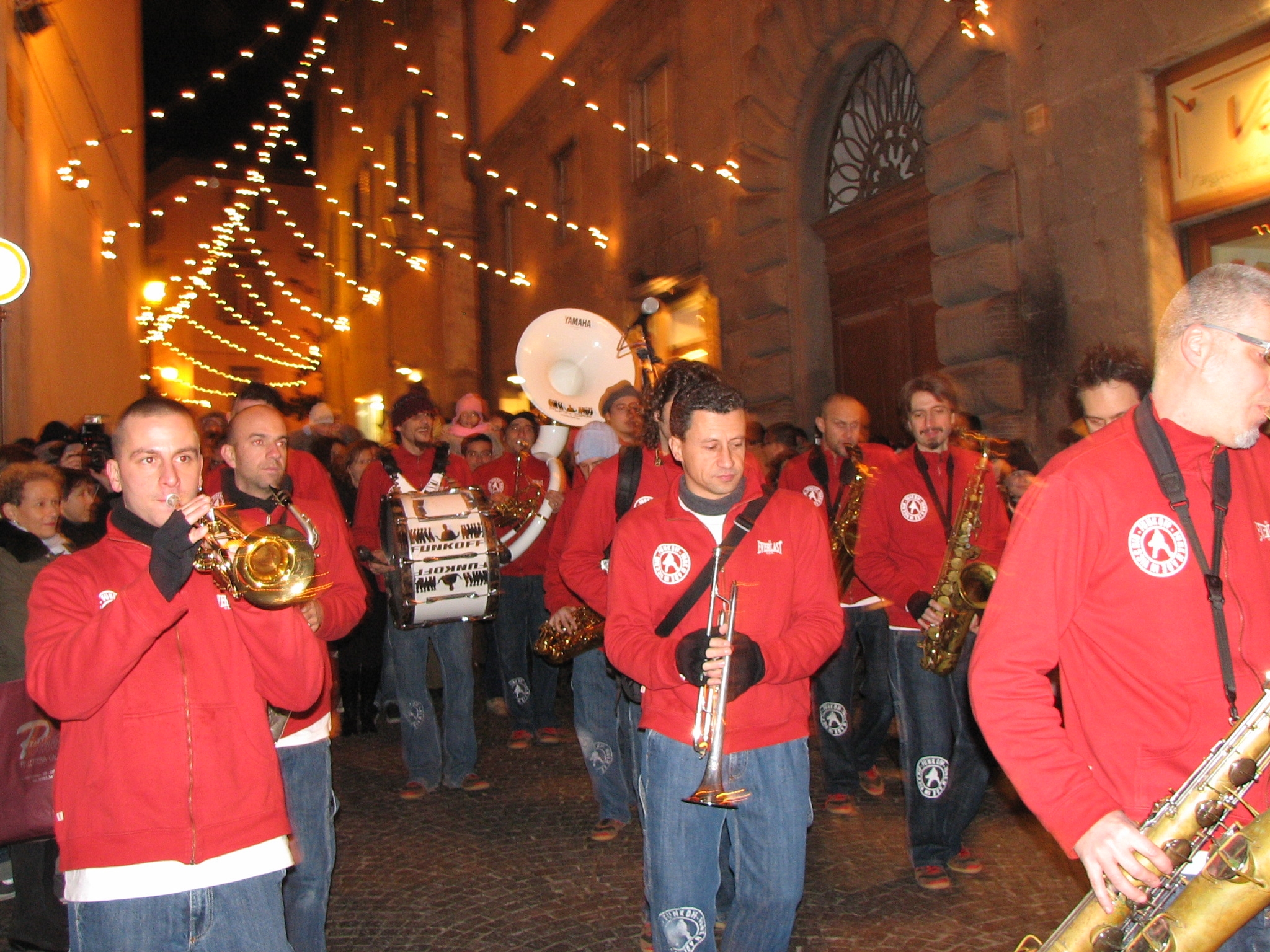
Like scrappy, bebopping Pied Pipers, Perugia’s popular street band Funk Off gets this party started with a nightly parade that snakes through Orvieto’s narrow and ancient cobblestone alleyways. Music lovers, young and old, scamper and skip behind these energetic hipsters as their infectious beat draws more and more followers along the route. The bluesy procession ends with an impromptu jam session in the Piazza della Repubblica, where you’ll find you can’t help but tap your feet, move your body and smile: It’s Umbria Jazz Winter #20 and “baby, it’s cold outside”.
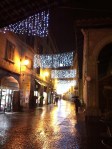 The international flavor and welcoming spirit amidst the holiday lights and chilly, frigid temperatures creates a unique atmosphere that makes this festival something special. For five nights, starting from December 28 to January 1, Jazz fans flock from all over Italy and beyond to partake in the music and brotherhood for which this festival has become world renowned. Performing on stage this year: Gregory Porter Septet, Dee Alexander & Evolution Ensemble, Tomeka Reid, Nicole Mitchell, Gary Brown & Feelings, Giovanni Tommaso Reunion Quintet, John Batiste, and many more.
 2012 goes out with a bang! Capodanno is celebrated in the Piazza del Popolo at midnight, ringing in the New Year with a fireworks display and free outdoor concert. On New Year’s Day arrive at the famous Duomo early to secure your spot for the first Mass of 2013. Inside this majestic Cathedral you’ll witness something you don’t see every day; hymns sung at a Roman Catholic “Mass for Peace and Gospel” by Dr. Bobby Jones and the Nashville Gospel Superchoir. Hold onto your seats because this joint will be jumpin’!
For more information about the festival go to: http://www.umbriajazz.com/Home.aspx
SEE YOUTUBE VIDEO OF FUNK OFF HERE:
Share this:

The Sicilian: Remembering My Father
Posted in Culture, Expat in Italy, Italian Culture, Italian-Americans, Italians, italo americano, Italy, Orvieto, Sicily, tagged Anzio, Luke DeBella, World War II on December 17, 2011| 23 Comments »

Luke Joseph DeBella: 1917 – 2004
As the 10-year anniversary of my father’s passing comes and goes, I have been thinking a lot about him and of the legacy he left behind. To say that he was my role model and hero seems trite — everyone says that about their father (if they are fortunate enough to have a strong man in their life to lead them into adulthood as I did). A man of few words, I learned what was most important by watching him conduct himself throughout his life and in his 52-year love affair with my mother. It was in this manner that I witnessed the qualities I wanted to emulate for myself. If I could only become half the person that he was…
 When my dad was a young man his nieces and nephews used to call him “Uncle Tootsy”. If you’d ever met this man you’d understand how ludicrous a moniker that was because my father’s reputation as a curmudgeon was legendary. He could come-off a little scary at first and often caused my friends at school to shiver in their boots. However, despite his well-executed “tough-guy” persona, once you got to know him you’d soon realized that his “schtick” was designed to hide one of the biggest and warmest hearts on the planet. Babies in particular adored my father – they were not fooled by his stern, gruff manner – they could see right through him into his soft, mushy center. My father had more friends than you could shake a stick at.
Dad was born at home in San Jose, California and raised in a house with 9 other siblings by Sicilian immigrant parents. Not formally educated past the 8th grade, he would religiously read the newspaper cover-to-cover every day and watch the news each evening. What my father lacked in academic knowledge he more than made up for in an uncanny intelligence for reading people.
At a young age my father learned his trade as a car mechanic and after returning from Europe at the end of World War II, he began an automotive repair business, “Luke and Martin Service”, in an old converted barn behind my grandparents’ house. When I was a little girl, I never hesitated to take the opportunity to boast about him. If a kid bragged that his father was a brain surgeon, I would shoot back, “Well, MY dad is a mechanic”! He worked in that capacity until he was nearly 75 years old because, I believe, his regular customers refused to let him retire. A good, honest and trustworthy auto repairman is really hard to come by.
He wasn’t the kind of guy to show off or talk about himself. He avoided people who put on “airs” or thought they were superior to others. He valued honor and respected hard work and straight talk. When I was a teen, he once said to me, “Being rich doesn’t make you happy”. My response back was, “That’s just what poor people say to make themselves feel better”, and he just smiled. He was crazy about Westerns (especially John Wayne and Clint Eastwood), and was an avid outdoor sportsman. By far, his favorite activity was to fish in a boat on a lake with his buddies. He was so passionate about it that my family had the words “Gone Fishing” carved into his gravestone. The cheekiness of that gesture would not be lost on him.

I guess the bottom line is that my dad was the “strong, silent type”. Not very demonstrative – he wasn’t much for talking about his “feelings”. In all honesty, I don’t remember my father ever saying the words “I love you” to me, however, there wasn’t a day that went by that I didn’t feel loved and cared for by him. Some people ‘talk the talk’ but he actually ‘walked the walk’ and taught me one of the most important lessons of my life so far: “Love” isn’t a noun, it’s a verb. by Toni DeBella
Share this:

Love Has an Expiration Date: Rome’s Ponte Milvio
Posted in Americans Abroad, Culture, Expat in Italy, Italians, Italy, Living abroad, Living in Europe, Living in Italy, Orvieto, Rome, Travel, tagged Federico Moccia, Fiume di Tevere, Love in Rome, Ponte Milvio, Tiber River on October 13, 2011| 2 Comments »
 For years young lovers have come to Il Ponte Milvio (Mulvian Bridge) in the north of Rome to declare their undying affection by writing their names on a lock, attaching it to a lamppost on the bridge and then throwing the key into the Fiume di Tevere (Tiber River) below. It’s a iron-clad promise to love each other until the end of time. Eternity ain’t what it used to be!
The bridge started attracting sweethearts after the publishing of Federico Moccia‘s popular book and film ““Ho Voglia di Te” (“I Want You”) in 2006. Unfortunately the barrage of locks started to bend the lampposts and the practice had to be limited to steel posts added by the Mayor. When the posts become filled, the locks must be removed to make room for newly-passionate visitors.
Perhaps it’s a sign of the times? Along with the City’s reasonable attempt to keep its infrastructure from crumbling under the weight of thousands of metal locks, the solution perhaps mirrors the devotion and commitment of modern couples these days. Happily ever after is hard to come by and having your declaration to the one you adore chopped-off by an orange suited city worker with a wire cutter seems to underscore the changing landscape of amore a Roma.
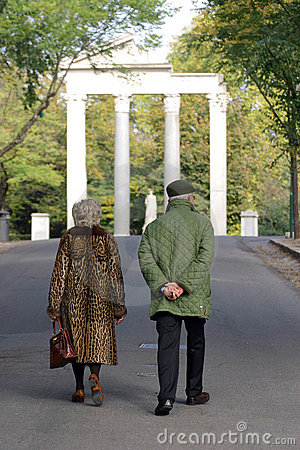 But being the hopeless romantic that I am, I like to imagine that someday an old couple will walk arm-and-arm across the Ponte Milvio and recall when they too placed a lock on this bridge to commemorate the beginning of their love story. They’ll smile because they’ll know that love can last even when the symbol of that love has long gone.
Share this:

Learning Italian by Osmosis
Posted in Americans Abroad, Culture, Expat in Italy, Italian Culture, Italian-Americans, Italians, italo americano, Living abroad, Living in Europe, Living in Italy, Orvieto, Travel, Umbria, tagged Commissario Montablano, Enrico Papi, Gerry Scotti, Groucho Marx, La Routa della Futura, Learn Italian, Millionario, Pat Sajak, Ryan Seacrest, Television, Tower of Babel, Victoria Silvstedt, Wheel of Fortune, Who wants to be a Millionare on September 24, 2011| 12 Comments »
“I find television to be very educating. Every time somebody turns on the set, I go in the other room and read a book.” –Groucho Marx

Television as a way to learn a foreign language is by no means a new concept. Since its inception in the late 1940s, newcomers have been using TV as a means to help them absorb their new language, and more importantly, to assimilate into their new culture. The conventional wisdom of linguists is there’s no relationship between watching television and mastering a language. I beg to differ. Based on only nonscientific anecdotal evidence (me), I assert that watching TV is a super supplement to other means of learning because it gives the viewer verbal as well as visual cues. You can look at it as a “workbook” in a box. With respect to colloquialisms that are spoken in everyday life, what better place to soak up slang than from a reality show or afternoon soap opera? After all, if it’s your intention to fit in and become part of your community, you’ll want to become familiar with the common vernacular.
Pantofolaio (Couch Potato) Beware!
Of course, it’s important to take an interactive role in  your “boob tubing”. Passively sitting back and letting the information wash over you isn’t going to cut it. Obviously television alone cannot replace formal training in grammar and vocabulary. However, if used deliberately and thoughtfully, TV can be an effective way to enhance your proficiency in three particular areas: pronunciation, commonly used expressions/vocabulary and popular trends.
Italian All day, every day
 Wake up and turn on your television set. You don’t necessarily have to be watching it to get the benefit – the background noise of Italians in conversation is seeping in. By bombarding your brain with the spoken word, you can train your “ear” to the musical rhythm and cadence of this beautiful language, and repeating words and phrases out loud helps with pronunciation. It’s like gymnastics for your tongue – reminding you of the importance of enunciating each and every letter to avoid changing a word’s meaning entirely, i.e., penne (a kind of pasta) and pene (penis). Otherwise, dialogue at the supermarket could get pretty interesting.
Are you listening to me?
Eavesdropping in public places – awkward. Watching a talk show in your living room – a much more relaxing way to pick up idioms in context (and with the accompanying hand gestures). Once I’d heard a phase used over and over, I would ask a friend its meaning and how to use it. For example, “Secondo me” came up a lot on political talk shows. I learned that it meant “in my opinion/in my view”. Once it made sense to me in its proper context, I could begin using it with confidence in my own conversations.
Around the Water Cooler
 You get a pretty good idea of the political climate of the country, its mores, values and attitudes with a healthy diet of current affairs programming. Who and what are in fashion can easily be gleaned from entertainment news and nighttime talk shows.
CATEGORICALLY SPEAKING…Types of Shows that give you the most “bang for your buck”:
#1 – Trivial Pursuit (Trivia Shows)
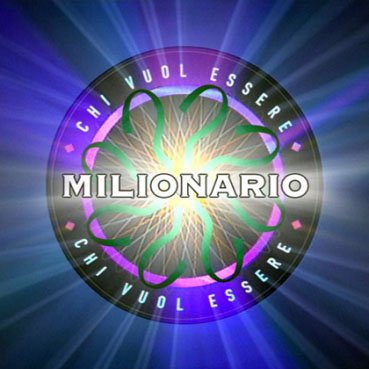 Millionario is one of my favorites. Gerry Scotti, (the Ryan Seacrest of Italy) hosts this country’s version of “Who Wants to Be a Millionaire”. The beauty of this show is that along with the questions posed to the contestant, you can read the question and possible answers on the screen. Are you a genius in English and Italian?
#2 -Games People Play (Game Shows)
La Routa della Fortuna is the Italian “Wheel of Fortune”. Enrico Papi is clever and better looking than Pat Sajak, but the real fun is kooky Victoria Silvstedt, a former Swedish Playboy Playmate ( “Vanna White‘s” counterpart). It turns out crossword puzzles are a lot easier in your native tongue. This show is a surprising mixture of trash TV and educational programming rolled into one crazy format. A wacky way to learn vocabulary!
 #3 – Series, Seriously (Episodic Series)
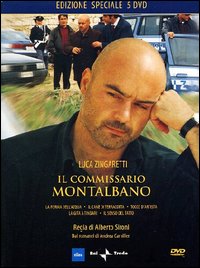
There’s a plethora of serial dramas and sitcoms – many imported from America – that are broadcast weekly (Commissario Montablano, CSI, Law and Order, House, Friends, etc.). I discovered that you can set most televisions to the closed captioning mode which allows you to watch and read the programs in Italian at the same time. It really works!
Television Tower of Babel
It all comes down to one thing: communicating. 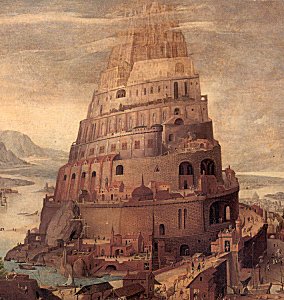 It seems television has become our modern day Tower of Babel that works to promote understanding by uniting people while acting as a sort of cultural equalizer. TV can make the world seem not just smaller, but downright miniscule. So, stay tuned!
by Toni DeBella
Share this:

How to Become an Italian Citizen in Only 989 Days
Posted in Americans Abroad, Culture, Expat in Italy, Italian Citizenship, Italian-Americans, Italians, italo americano, Italy, Living abroad, Living in Europe, Living in Italy, Orvieto, Sicily, tagged citizen of Italy, Consolato Generale D'Italia a San Francisco, Contessa Entellina, Corleone, DeBella, How to become an Italian Citizen, Italian citizenship, Italian dual citizenship, Sicily on September 11, 2011| 14 Comments »
 The letter from the Consolato Generale D’Italia a San Francisco arrived in the mail today. The words inside the envelope were a culmination of three long years of hard work and dogged determination: 31/08/11 Dear Ms. DeBella: “I am pleased to notify you that your Italian citizenship has been recognized and that your certificate(s) have been forwarded to the Italian municipality of CORLEONE (PA) for recording.”
Somehow I envisioned this auspicious occasion much differently. There were times when I wondered if this day would ever come. And if it did arrive, I imagined it would be filled with much fanfare, jumping up and down, and screaming. Instead it was a quiet moment. A solitary moment. A very personal moment. It was a time to reflect on what it took for me to get to this place: Patience, tenacity, belief, humor, and a clear intention. August 31, 2011 is the day I became a citizen of Italy.
Italian by Blood Jure sanguinis (“right of blood”) contrasts with jus soli (Latin: “right of soil”) in that citizenship is not determined by place of birth, but rather by having a parent (or decendent) who is a citizen of a nation. In Italy there’s no limit to the generations that can obtain citizenship via blood (except for specific constraints which did not apply to me). Furthermore, because the U.S. and Italy have a reciprocity agreement, one is allowed dual citizenship.
After tracking down my grandparents’ birth certificates (likely located in books archived in church basements of Corleone and Contessa Entellina), respectively, I gathered together some twenty other documents (i.e., birth, death, divorce) for both myself and members of my immediate family. Translations and Apostilles followed, along with a list of discrepancies and misspelled names (of which there were many). And don’t even get me started on the rabbit hole that is the U.S. Department of Homeland Security! This part of the process took a little over a year to complete. Then there was the waiting period (one-and-a half years, to be exact) for an appointment to personally submit my application to the Italian Consulate.
The procedure was daunting, frustrating, and at times discouraging. When I felt like giving up, I thought about the finish line — life in Italy — which helped to spur me on. I suppose that if becoming a citizen of a country were easy, everyone would do it. You really have to want it!
The Gift

I Nonni DeBella, San Jose, California
Throughout these three years I’ve been fortunate to have the support and encouragement of friends and family, both in the U.S. and Italy. But it was my grandparents, Jake (Gioachino) DiBella and Emma (Ninfa) Pizzo, who deserve my utmost thanks and gratitude for without them none of this would be possible. In the late 1880s, they came to this country as young immigrants from Sicily. They married, worked hard, and raised a family of ten children. I wonder what they would have thought about their granddaughter one day returning to the land they left behind.
It appears that the DeBella family, in the not-too-distant future, is about to come full circle.
Share this:

Grandma versus The Evil Spirits
Posted in Culture, Italian Culture, Italian Superstitions, Italian-Americans, Italians, italo americano, Italy, Living abroad, Living in Europe, Living in Italy, Orvieto, Rome, Sicily, Travel, Umbria, tagged 4-leaf clover, Chinese coin, Contessa Entellina, Italian Superstitions, Judith Viorst, Malocchio, Mati, Palazzo in Orvieto, Palermo, St. Peter's Square on September 3, 2011| 4 Comments »

I have never been overly-superstitious and take great pride in my healthy cynicism. I don’t throw salt over my shoulder or avoid black cats. As a muralist, I walk under ladders frequently and don’t believe I have ever fallen victim to the evil eye. Thinking or saying something out loud does not make it come true. If it did, I’d be a size 6, rich and living in a palazzo in Orvieto. But I digress.
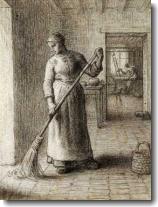 My grandmother was normally a very serious and solemn woman. One day a year she would transform into a madwoman, wielding a broom and running in circles shouting and screaming like a banshee in an effort to ward off the evil spirits who had apparently taken up residence in our cellar. It was spring cleaning run amok. I don’t know much about the tradition that had this small, fragile and shy lady fearlessly take on a bunch of ghosts in the basement of our house. I wonder if it was folklore passed down from her childhood in Contessa Entellina, a small Sicilian town 80km from Palermo. I did a little research and found quite a few references to sweeping away evil spirits with a broom — a common practice especially among southern Italians, but was unable to find any mention of the “screaming and running around” part. Perhaps that was my grandmother’s own personal stamp on the custom.
Superstitious Minds
A superstition is a belief in something that has no rational foundation in science and is most often based on the prevailing religion or culture that contains these otherworldly beliefs. The word comes from the classical Latin superstitio, meaning “a standing over [in amazement]”.  Greek and Roman pagans were believed to have scorned men who displayed a fear of the gods and thus, the behavior came to be referred to as superstition. This could explain why Greeks and Italians are famously known for their mythology and have a common legend in the “evil eye” – Malocchio in Italian, Mati in Greek.
Hope-On-A-Rope
When I wrote earlier that I am not particularly superstitious, I wasn’t being completely honest with you. The fact is that in the last few years I have come to believe a certain necklace I own has developed supernatural powers that, if worn daily, will someday bring me good luck.
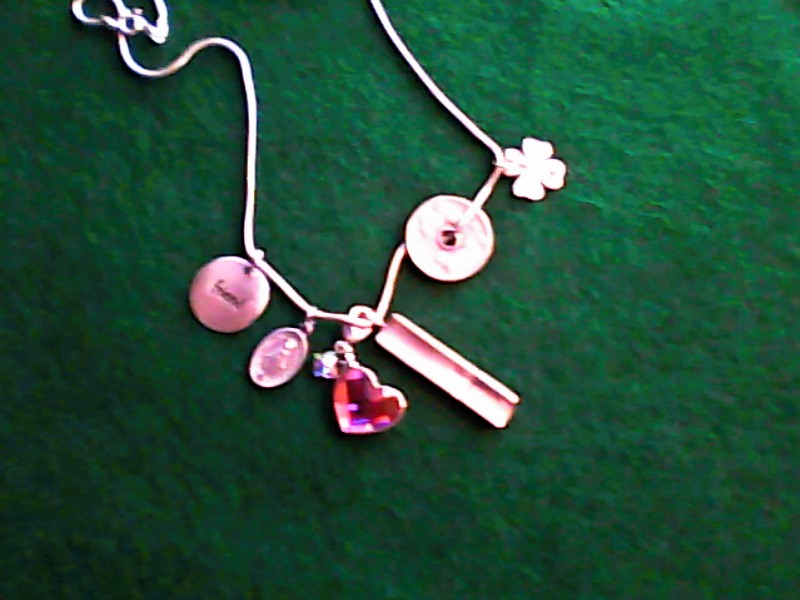 It started out as a simple chain with a silver bar hanging from it. One afternoon while in St. Peter’s Square I looked down to see something glittering in the sun. I removed it from between the cobblestones to discover it was a tiny medallion of the Madonna. Convinced this was an omen, I instinctively hung it onto my necklace. A birthday present of a charm with the word “Friend” engraved on it followed — then a Chinese coin and a 4-leaf clover. On one arrival in Rome I wrote the message to my friend Angelo, “Io sono in Italia…mi sento come una farfalla” (I am in Italy…I feel like a butterfly). When he presented me with the gift of a tiny crystal butterfly dangling from a pink heart of course I had to add it to my collection. This “chain of fortune” is getting rather heavy!
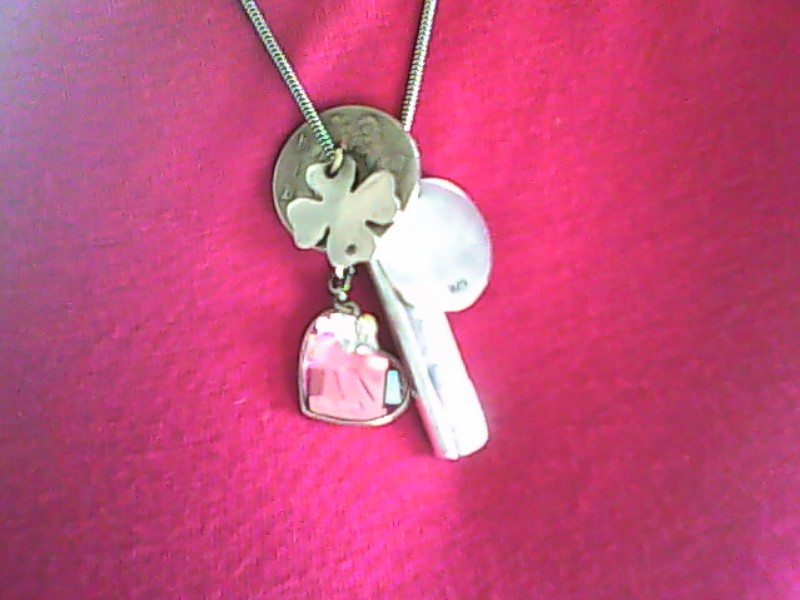 Out of the 365 days in a year, I probably wear the necklace 360 of them. The other 5 days I just don’t feel quite right without it. Could I have inherited from Grandma this propensity to make weak associations of cause and effect where there are none? What can I say? I don’t like tempting fate. Writer Judith Viorst said it very well: “Superstition is foolish, childish, primitive and irrational — but how much does it cost you to knock on wood?”
by Toni DeBella
Share this:

Painters in the Piazza
Posted in Artists on Piazza Navona, Expat in Italy, Italians, Italy, Living in Europe, Living in Italy, Piazza Navona, Rome, tagged Bernini, Fontana dei Quattro Fiumi, Fountain of the Four Rivers, George Bernard Shaw, Massimilliano Balletti, Painters on Piazza Navona, Piazza Navona, renaissance, Rome on August 13, 2011| 4 Comments »

“A picture is a poem without words.” -Horace
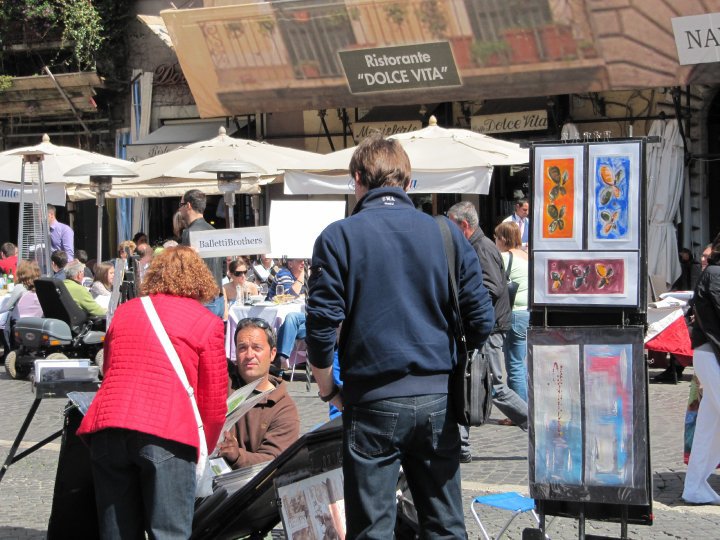
A revolution has been brewing for almost a decade on the Piazza Navona, one of the most famous and historic squares in Europe. Millions arrive to see Bernini’s magnificent Fontana dei Quattro Fiumi (The Fountain of 4 Rivers) and to stroll along the road, hoping to acquire an original picture of a Roman scene painted and signed by the artist in front of them. Now the tensions are high: real artist are pitted against counterfeit ones.
“Art is not a thing, it is a way.”- Elbert Hubbard
I can’t intelligently speak to the political or economic ramifications of the most recent decree approved by the City of Rome to regulate painters and street artists on the piazza. What I can say with certainty is that I believe society is obligated to defend those among us who have the ability to suspend reality and, with a brush in hand, transfer it onto a canvas to make a thing more beautiful – to make l’arte. George Bernard Shaw said it best when he wrote,“Without art, the crudeness of reality would make the world unbearable.”

Performance Artist
In 2005, the Mayor and Council approved a ban prohibiting any type of commercial activity in the center of Piazza Navona. It was declared that permits would no longer be issued to paint in the city. Then came a resolution to govern the artistic profession, but nothing came of it. Nearly 6 years later the absence of rules means anyone (real artists and fakers) can enter and do what they want. The result has been a dilution of creativity and a strengthening of chaos and clutter. The legitimate are at a disadvantage to the counterfeiters who defraud tourists by peddling reproductions passed-off as originals. But why should the artists, some of whom have been on the Piazza since the 1960s, 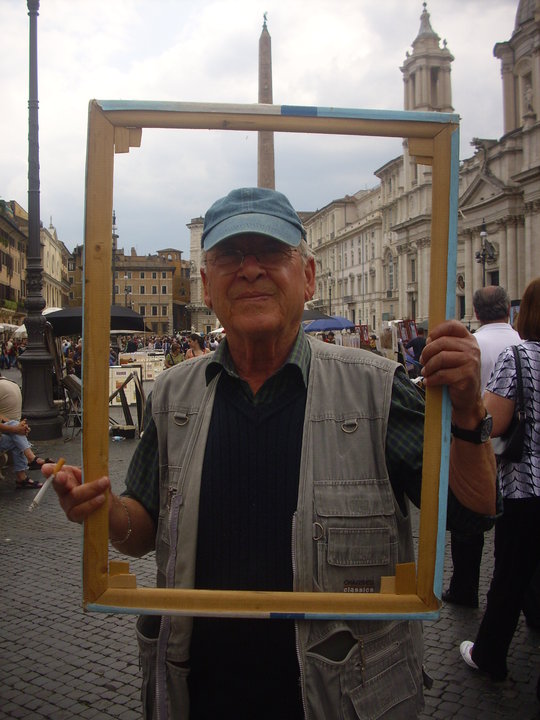 pay the price for the City’s failure to control those who bring urban decay to this beautiful place? Why should the people who have promoted all that is good about the Eternal City and have contributed to its charm and mystique now be threatened with displacement? Leonardo is turning in his grave!
“No heirloom of humankind captures the past as do art and language.” – Theodore Bikel
What is at stake on the Piazza Navona is the keepsake of a city. Art has defined Italy since the renaissance and just like the oxygen in our atmosphere, civilization and Rome need it to survive.

Photographs by Toni DeBella and Massimilliano Balletti
Paintings by Massimilliano Balletti
Share this:

Vola, Colomba Bianca, Vola!!! Sunday, June 12, 2011
Posted in Culture, Festivals in Italy, Festivals in Umbria, Italians, Italy, Living in Italy, Orvieto, Travel, Umbria, tagged Duomo Orvieto, Festa Della Palombella, la colomba, lo Spirito Santo, The Holy Spirit, The Pentecost on June 16, 2011| 2 Comments »

Each Pentecoste Sunday for centuries, a large crowd gathers in front of the Duomo di Orvieto to celebrate the Festa della Palombella. Despite the condemnation of animal rights advocates, a dove is placed in a plexiglass “space capsule” and launched on a zip-line across the Piazza. It arrives at the specially constructed cenacle with great fanfare of fireworks, red flames and clouds of smoke. The dove symbolizes the descent of lo Spirito Santo (the Holy Spirit) on the Apostles. It’s said that if the dove survives the traumatic journey, it portends a year of good crops and fertility for the city’s most recently wed couple, who vow to care for the dove until its natural death.
Apparently, this year “la colomba” had other plans! Somehow the container had opened prematurely and amidst a cheering crowd, the dove made her daring and defiant escape – literally and figuratively – she “flew the coop”.  The question remains: If a “surviving” dove signifies a year of favorable crop yields and a “deceased” dove predicts a weak harvest, then it’s good news for farmers since a liberated dove is certainly “alive and well”.
But what is the fate of the newlyweds who were deprived of their blessing of peace and fertility? I have no doubt that every bar in town is humming with speculation about this twist of fate! The discourse and theorizing could go on for the next 365 days!
by Toni DeBella
Share this:

-
On my mind.
- The Pandemic Era
- I’m Broke and I’m Going on a Shopping Spree
- On day one there was sunshine. On day two there are clouds
- Silver Linings
- On the Island of Orvieto
- 7 Things to Know If YuBike in Amsterdam
- Do You Dream of Italy? Why Not Come and Paint it? 2nd Annual Sketching Workshop in Orvieto, September 22-29, 2019
- Exploring Orvieto: Watercolor Sketching in the Perfect Italian Hill Town
- Orvieto: It’s NOT Just a Day Trip From Rome
- How to Vote in Italy: 8 simple steps
- 11 Things You Need to Stop Doing on Social Media
- Mini-Vacation: Two Days on The Isle of Capri
- Vicolo Wars: The Cease-Fire
- A Tale of Two Bookstores
- The Golden Statue Watching Over Rome’s Termini Station
- Marrakesh, Morocco: 5 Astonishing Things I Never Expected!
- I Live in Italy, But I’m Still An American
- High School Reunion on a Stick
- An Alien in San Francisco
- The Local Italy Gives Orvieto a ‘Shout Out’
Archives
-
Join 1,176 other subscribers
-
Toni DeBella

Create Your Badge<!-- Facebook Badge END

Add blog to our blog directory.


- Follow Orvieto or Bust: on WordPress.com

 Orvieto or Bust: